Chicken Breast: Oven to Air Fryer Conversion
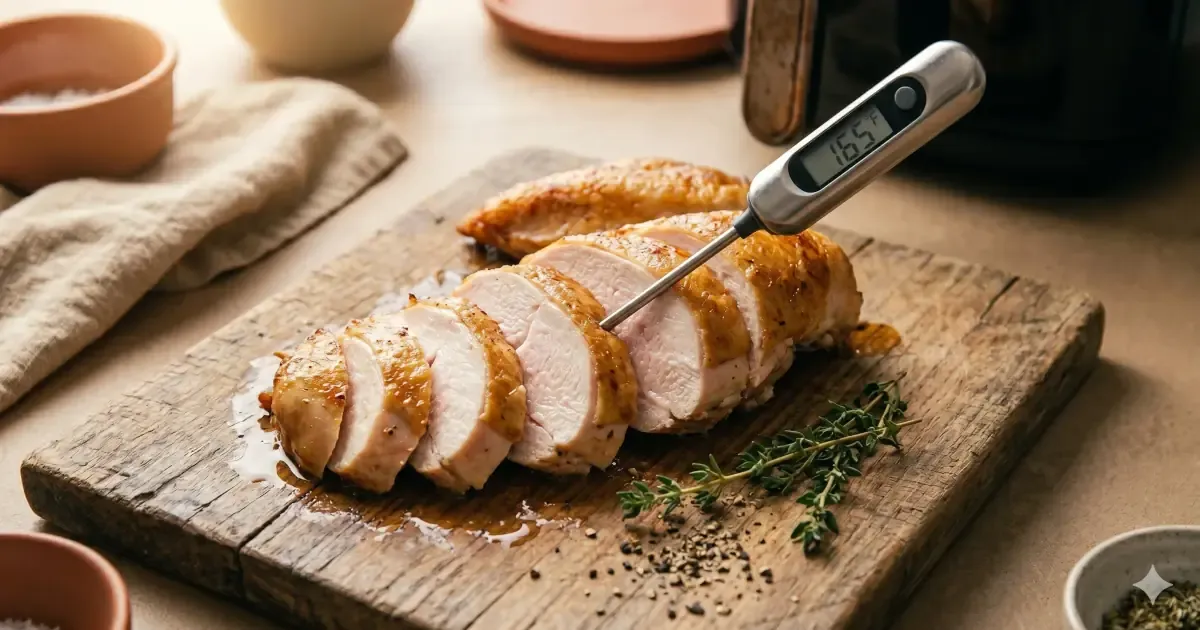
Chicken breast is one of the most-searched air fryer foods in America, and for good reason: it's the core of meal prep, weeknight dinners, and high-protein lunches. But lean meat is unforgiving. A few extra minutes mean the difference between juicy and rubbery.
The conversion from oven to air fryer is simple, but the execution requires attention to three details most guides ignore: thickness (not weight) determines time, carryover cooking adds 3°F after pulling, and the USDA target is 165°F for food safety.
Recipe steps
1. Measure and pound
Measure the thickest part of each breast. If over 1.25 inches, pound flat between plastic wrap to an even thickness so the breast cooks uniformly.
2. Dry, oil, and season
Pat dry with paper towels, spray 1 teaspoon oil per 2 breasts, then season with salt and dry spices. Moisture on the surface prevents browning.
3. Cook at 360°F
Place in a single layer with 1 inch between pieces. Cook at 360°F for 15 minutes (6 oz / 1 inch) or 18 minutes (8 oz / 1.25 inch), flipping halfway.
4. Pull at 162°F and rest
Probe the thickest part. Pull at 162°F internal; carryover brings it to the USDA-safe 165°F during rest. Rest 5 minutes before slicing.
Quick Reference by Thickness
Internal target per USDA FSIS: 165°F (74°C). Pull at 162°F for 3°F carryover.
| Cut / Thickness | Oven | Air Fryer |
|---|---|---|
| 6 oz / 1" thick | 375°F / 22 min | 360°F / 15 min |
| 8 oz / 1.25" thick | 375°F / 25 min | 360°F / 18 min |
| 10-12 oz / 1.5"+ thick | 375°F / 30 min | 360°F / 22 min |
| Thin-sliced cutlet | 375°F / 15 min | 360°F / 8 min |
| Frozen (6 oz) | 400°F / 40 min | 360°F / 25 min |
Always flip at the halfway mark. Use an instant-read thermometer; color is not a reliable doneness indicator for chicken.
The 25-25 Rule Applied to Chicken Breast
The standard oven-to-air-fryer rule drops temperature by 25°F and cook time by 20 percent. For chicken breast, we drop slightly more on temperature: oven 375°F becomes air fryer 360°F. That extra 5°F reduction prevents the concentrated airflow from drying lean meat before the center cooks through.
Time follows roughly a 70 percent ratio. A 25-minute oven breast becomes 18 minutes in the air fryer. The concentrated airflow browns the surface fast while the moderate temperature keeps moisture in.
Thickness Matters More Than Weight
Most conversion charts list chicken breast by weight, but weight is a poor proxy. A 10-ounce thin cutlet cooks completely differently than a 10-ounce thick breast, because heat travels inward at roughly 1.5 minutes per quarter-inch of thickness.
Before cooking, measure the thickest part of each breast. If it exceeds 1.25 inches, pound it flat with a meat mallet between two sheets of plastic wrap, or butterfly it with a sharp knife. Uniform thickness produces uniform cook: the single most important step for not ending up with rubbery chicken.
For batch meal prep, select breasts of similar thickness and cook them in one session. Mixing 0.75-inch cutlets with 1.5-inch whole breasts guarantees some pieces will be overdone.
Step-by-Step for Juicy Chicken Breast
- 1Pat chicken thoroughly dry. Moisture on the surface prevents browning.
- 2Light oil spray (1 teaspoon for 2 breasts), then season with salt and dry spices.
- 3Place in a single layer with 1 inch of space between each piece. No stacking.
- 4Set 360°F for the time listed in the chart for your thickness.
- 5Flip at the halfway mark for even browning on both sides.
- 6Probe the thickest part at the end of the cook time. Target: 162°F (pull for carryover to 165°F).
- 7Rest for 5 minutes before slicing so juices redistribute through the meat.
Bone-In Split Chicken Breast
Bone-in split breast (10-12 oz with rib bone attached) takes significantly longer than boneless because the bone insulates the meat nearest it. Budget 28 minutes at 360°F, with a flip at the halfway mark and the skin-side down first.
The extra 6-10 minutes versus equivalent boneless weight is the bone conduction effect: heat has to travel through dense calcium tissue before reaching the meat's center.
USDA 165°F target remains unchanged. Probe the thickest part of the meat away from the bone, since temperature readings near bone are misleadingly low.
Carryover Cooking Explained
Carryover cooking is the temperature rise that happens after you pull food off the heat. For chicken breast in an air fryer, the outer surface reaches roughly 200°F during the cook, and that residual heat continues migrating inward for 3-5 minutes after you stop cooking.
In practice: pull at 162°F internal. Rest for 5 minutes. The temperature rises to 165°F, your USDA-safe target, exactly when you're ready to slice.
Skip the carryover adjustment and the chicken reaches 168-170°F at rest, which is measurably drier. Every 3°F above 160°F in chicken breast costs roughly 1 percent water content. Nobody tastes 1 percent, but 5-8°F overshoot is the difference between juicy and sawdust.
Dry Rub Burn Risk
Paprika, brown sugar, and chili powder all contain enough natural sugar to burn at 360°F+ in an air fryer's concentrated airflow. If you're using a sugary dry rub, either (a) apply it after cooking as a dust, (b) drop the air fryer temperature to 340°F and add 3 minutes to the cook time, or (c) rub it on only during the last 4 minutes. The scorched-spice smell is unmistakable; if you've gotten it once, you'll recognize it instantly.
Cooking Frozen Chicken Breast Directly
A frozen 6-ounce chicken breast cooks in 25 minutes at 360°F without thawing. No extra prep, no foodborne illness risk; the cook time is long enough to fully pasteurize.
Quality is slightly lower than from fresh: surface browning is weaker because the thawing skin releases moisture for the first 5 minutes. Don't skip the instant-read check at the end. Ice crystals in the thickest part of a frozen breast can leave a lower-temp core even when the exterior looks done.
For meal prep, cooking from frozen is a real time saver: load the basket from the freezer, start the timer, walk away.
Troubleshooting
Dry / rubbery
Overcooked; pull at 162°F for carryover to 165°F, and always rest 5 minutes before slicing.
Raw center
Pieces too thick. Butterfly or pound to uniform 1-inch thickness before cooking.
No browning
Excess surface moisture. Pat dry thoroughly and use a light oil spray before seasoning.
Unevenly cooked
Inconsistent thickness; trim or pound pieces to match before cooking.
Tough texture
Skipped the rest time. Always rest 5 minutes off heat so juices redistribute.
Burned spices
Sugary dry rub at 360°F. Drop to 340°F and add 3 minutes, or apply rub only in the final 4 minutes.
Food Safety: USDA 165°F Is Non-Negotiable
USDA FSIS requires all poultry reach an internal temperature of 165°F (74°C). Use an instant-read thermometer probed into the thickest part of the meat, away from bone if present.
Color is unreliable. Pink chicken can be fully safe (165°F with a slightly pink hue from myoglobin), and white chicken can be undercooked. Trust the thermometer.
Cross-contamination is the most common failure mode. Sanitize cutting boards and knives after raw chicken prep. Never return cooked chicken to a plate that held it raw without washing first.
Store leftovers within 2 hours at 40°F or below. Reheat to 165°F before eating. The air fryer at 350°F for 4 minutes is the fastest reheat path while keeping moisture.
Marinades and brines that survive air-fryer airflow
Wet marinades and air fryers are a bad pairing. The 12-meters-per-second airflow strips the marinade off the surface and onto the heating element, where the sugars and oils smoke immediately. The result: a charred bottom basket, a sharp burnt smell that lingers for the next two cooks, and chicken that tastes washed instead of seasoned.
Dry brining is the air-fryer-friendly alternative. Salt the chicken breast at a rate of 3/4 teaspoon kosher salt per pound, distributed evenly on all surfaces. Place uncovered on a wire rack over a plate and refrigerate 30 minutes minimum, 4 hours ideal, 12 hours for the deepest cure. The salt draws moisture out, then dissolves into a concentrated brine that re-absorbs into the meat. Same hydration and seasoning effect as a wet brine, no surface liquid to drip into the air fryer.
If you want garlic, herbs, or spice flavor, mix them into the dry brine: 1 teaspoon garlic powder, 1 teaspoon smoked paprika, and 1/2 teaspoon black pepper per pound. Avoid wet aromatics (fresh garlic paste, mustard, soy sauce) until after cooking. Applied as a finishing baste in the last 60 seconds, they get the flavor without the burn.
Yogurt-based marinades (tandoori-style, Greek-style) are the one wet exception that works. The lactic acid tenderizes without breaking the surface down, and the yogurt clings to the chicken without dripping. Marinate 1 to 4 hours, scrape off excess yogurt before cooking (leaving a thin coat is fine), and cook at the standard 360°F. Yogurt browns into a deep golden crust without burning.
Acid-based marinades (lemon juice, vinegar) work as 30-minute pre-cooks but no longer. The acid denatures the surface protein and produces a mealy texture beyond 30 minutes. Always pat the surface dry before air-frying any marinated chicken, regardless of marinade type.
Meal prep: 4 servings of chicken breast in one cook
Air fryer meal prep maxes out at four 6-ounce chicken breasts in a 5.8-qt square basket (Cosori Pro II) or three breasts in a 4-qt deep oval (Ninja AF101). The constraint is single-layer arrangement; stacking guarantees uneven cook and at least one rubbery breast in the batch.
Method: pound or butterfly all four breasts to uniform 1-inch thickness. This is the single most important step for batch cooking, because mixed thickness produces mixed doneness. Dry-brine for 30 minutes minimum at 3/4 teaspoon kosher salt per pound, plus 1 teaspoon paprika and 1/2 teaspoon garlic powder per breast. Pat dry. Light oil spray. Arrange in single layer with 1/2 inch between pieces. Cook at 360°F for 18 minutes, flipping at minute 9.
Storage timeline per USDA FSIS: cooked chicken breast is safe for 4 days refrigerated at 40°F or below. Cool to room temperature within 2 hours of cooking, then refrigerate. For longer storage, freeze within 24 hours of cooking; frozen cooked chicken breast holds quality for 2 to 3 months at 0°F or below.
Reheating without drying out: 350°F for 4 minutes for refrigerated, 6 minutes for frozen. The single most common meal-prep mistake is reheating to 165°F internal. That overshoots because the chicken is already cooked. Reheat only to 140°F to 150°F internal; the chicken is already past USDA-safe at original cook, so the reheat is purely for serving warmth, not food safety. Slice while warm rather than cold; the cuts hold moisture better.
Sauces that work after air-frying chicken breast
Lean chicken breast benefits from a sauce because the meat itself runs drier than thigh. The rule: apply sauce after cooking, not during, for any sauce containing more than trace sugar. Air-fryer airflow burns sauces at 360°F+ within 3 to 4 minutes.
Best post-cook sauces by category. Pan sauces (lemon-butter, white wine garlic, browned-butter sage) work because they're thin and re-warm without breaking; whisk over low heat in a small saucepan and spoon over the rested breast. Yogurt-based sauces (tzatziki, raita) work cold against warm chicken; the temperature contrast is the appeal, and yogurt sauces don't need cooking. Pesto and chimichurri spread directly on the warm sliced breast without further treatment.
Sauces to avoid mid-cook: BBQ sauce, teriyaki, honey mustard, sweet chili. All of these burn at air-fryer temperatures. The workaround is the last-3-minute brush: cook the chicken to 90 percent doneness (15 minutes for an 8-oz breast), brush sauce on, return at 400°F for the final 3 minutes. The high heat caramelizes the sauce into a glaze without burning. Probe to confirm 165°F internal before pulling regardless of sauce.
Frequently Asked Questions
What temperature do you cook chicken breast in an air fryer?
Cook chicken breast at 360°F (182°C). Lower than wings or nuggets because the lean meat dries quickly at higher temperatures. Always verify 165°F internal temperature before serving.
How long do you cook chicken breast in an air fryer?
A standard 8-oz, 1.25-inch thick chicken breast cooks in 18 minutes at 360°F, flipping at halfway. Thinner cutlets finish in 8 minutes; larger 10-12 oz pieces need up to 22 minutes.
How do you keep air fryer chicken breast juicy?
Three things: pat dry before cooking, pull the chicken at 162°F (3°F below target for carryover), and rest for 5 minutes before slicing. Dry brining 30 minutes ahead also helps.
Can you cook frozen chicken breast in an air fryer?
Yes. Frozen chicken breast cooks in 25 minutes at 360°F without thawing. Use an instant-read thermometer to confirm 165°F internal; don't rely on time alone.
Do I need to flip chicken breast in the air fryer?
Yes, flip at the halfway point for even browning. Unlike wings, chicken breast has flat surfaces that benefit significantly from flipping.
Why is my air fryer chicken breast dry?
Overcooking is the cause 95% of the time. Pull at 162°F for 3°F carryover to 165°F, and rest for 5 minutes before cutting. Also: pat dry before cooking, and pound thick breasts to 1" uniform thickness.
Is air fryer chicken healthier than oven?
About the same nutritionally, since both use dry heat with minimal oil. The air fryer cooks faster, which means less moisture loss and, in practice, more tender chicken, especially for lean breast meat.
Sources & references
Internal-temperature claims on this page link to primary food-safety sources. The carryover-cooking value is derived from in-kitchen testing.
USDA FSIS Safe Minimum Internal Temperature Chart
The 165°F target for cooked poultry referenced throughout this guide.
Health Canada Safe Internal Cooking Temperatures
Canadian guidance: 74°C / 165°F for poultry, used as the cross-reference target.
Harold McGee, On Food and Cooking (Scribner, 2004 revised edition)
Reference for the carryover-cooking principle and protein moisture loss curves discussed in the carryover section.
Cosori Pro II 5.8-Qt Manual
The Chicken preset (380°F for 23 minutes) and the instruction not to fill the inner basket above its MAX line or pack food in, behind the single-layer loading advice.
Bottom Line
Juicy chicken breast in the air fryer is three things: pat dry, 360°F, pull at 162°F and rest. That's it.
Weigh accuracy against thickness every time. A thermometer is the single tool that separates restaurant-quality chicken from the rubbery leftovers everyone complains about.