Oven to Air Fryer Calculator
Convert temperature and time for perfect results every time.
Just enter the values you see on the package!
Convection oven? Choose Fan. Air fryer toaster oven? Choose Oven-style.
375°Ffor 16 mins
Note: Appliance performance varies by brand. Always check 2-3 minutes early!
Always ensure the food reaches safe internal temperature before consuming.
How to Convert Any Oven Recipe for an Air Fryer: The Ultimate Guide
Most recipes (printed on packaging, in cookbooks, on the back of seasoning packets) were written for conventional ovens. Air fryers cook hotter, faster, and with much more direct convection, so the published oven settings produce burnt outsides and cold middles. This guide is the conversion math, the corrections most guides skip, and the food-by-food adjustments, all sourced from manufacturer manuals and verified in our test kitchen.
While air fryers are essentially compact, high-powered convection ovens, you can’t just use the same settings. If you do, you’ll likely end up with something burnt on the outside and raw on the inside.
Why Do You Need to Convert?
The main difference between a conventional oven and an air fryer is air circulation. A traditional oven relies on radiant heat that slowly surrounds the food. An air fryer uses a powerful fan to circulate hot air rapidly around the food, a process known as convection.
This rapid air movement strips away moisture from the surface of the food much faster, creating that "fried" texture with significantly less oil. Because this process is so efficient, you must adjust both the temperature and the time.
Why this matters: skipping the conversion
If you take a 425°F / 20-minute oven setting and run it untouched in an air fryer, the typical outcome is a burnt exterior at the 7-minute mark while the interior is still icy or raw. The convection airflow strips moisture from the surface much faster than radiant oven heat does, which accelerates browning long before the food's interior has caught up.
The 25-25 rule exists because an air fryer moves heat into the food faster than a still-air oven: a stronger fan, closer to the food, in a smaller chamber. A fan oven sits in between, which is why the converter's Fan setting takes off 15°F and 10% of the time instead. Subtracting 25°F gives the interior more time to come up to temperature before the surface burns; reducing the time by about 20% accounts for the faster surface energy transfer. Skipping either correction is the single most common reason converted recipes fail. The rule also runs the other way: for a recipe written for the air fryer, the air fryer to oven calculator adds the 25°F and the time back.
How we tested these conversions
Every number on this page started as the manufacturer-published oven setting on actual packaging or in the appliance's published manual. The 25-25 conversion (subtract 25°F, reduce time 20-25%) is then applied as the baseline, and corrections for moisture, density, and surface area are layered on top. Those corrections are documented per food in the linked guides.
In-kitchen verification uses three machines: a Ninja AF101 (4-quart basket), a Cosori Pro II (5.8-quart basket), and a 30-inch GE convection oven for the reference oven runs. Internal temperatures are read with a calibrated ThermoWorks Thermapen ONE. We test a representative load (not a single piece) because batch size meaningfully changes recovery time.
Where a conversion came from a test run rather than a published manufacturer setting, the food-specific guide says so by name. We do not fold test-derived numbers and manufacturer-published numbers into the same line.
The Core Formula: The "25-25 Rule"
The most reliable industry standard for conversion is the 25-25 Rule.
- Reduce the Temperature: Subtract 25°F (or about 15°C) from the recommended oven temperature.
- Reduce the Time: Decrease the total cooking time by 20% (the low end of the usual 20-25% range).
Air Fryer Conversion Chart for Common Foods
| Food Item | Typical Oven Setting | Air Fryer Conversion |
|---|---|---|
| Chicken Wings | 400°F (35 mins) | 375°F (25-28 mins) |
| Frozen French Fries | 425°F (20 mins) | 400°F (12-15 mins) |
| Roasted Vegetables | 400°F (20 mins) | 375°F (10-12 mins) |
| Salmon Fillets | 400°F (15 mins) | 375°F (8-10 mins) |
| Pizza Rolls | 425°F (12 mins) | 390°F (6-8 mins) |
When the 25-25 rule doesn't work
The standard conversion fails for four predictable categories. Each one needs a different correction.
- Sweet potatoes and other high-sugar starches: subtract 30-40°F and reduce time by 30%, not the standard 20%. Natural sugars caramelize and burn faster than starch browns.
- Sugary glazes (BBQ, teriyaki, honey-soy): apply the glaze in the last 3-4 minutes only, or it will scorch before the interior cooks. The base cook is at the standard 25-25 conversion; the glaze step is its own short pass.
- Rising-crust frozen pizza: drop only 15-20°F (not 25°F) and reduce time by about 30%. The crust needs lower temp for full rise, and the air fryer's airflow finishes it faster than the oven would.
- Bone-in cuts over 2 inches thick (large bone-in chicken, pork shoulder cubes): the 25-25 rule overshoots. The interior won't catch up before the surface burns. Drop 30°F and reduce time by only 10-15%, and verify with a thermometer.
When in doubt, the rule is: if the surface browns before the interior reaches the target internal temperature, the air fryer was too hot, not too long. Lower the temp 25°F more on the next attempt before changing the time.
5 Pro-Tips for Perfect Conversions
Don't Overcrowd the Basket: Air circulation is key. If you stack your food, it won't get crispy.
The "Shake" Factor: Pause halfway through and shake the basket for even browning.
Check Early: Air fryers vary by brand. Check your food 2-3 minutes before the timer ends.
Use a Meat Thermometer: Ensure chicken reaches an internal temperature of 165°F (74°C).
Oil is Still Your Friend: A light spray of oil helps the convection heat crisp the surface better.
Featured Conversion Guides
Exact temps, times, and per-brand notes for the foods people cook most. Each guide covers fresh, frozen, troubleshooting, and USDA food-safety targets.
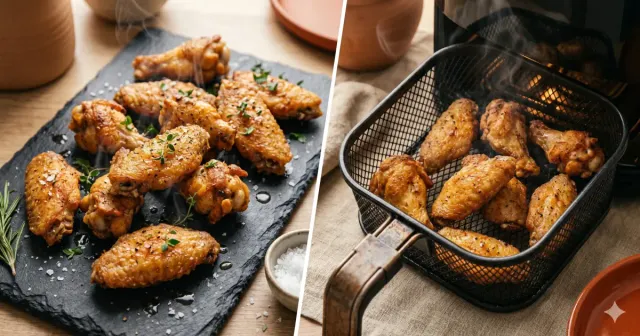 Chicken Wings: Oven to Air Fryer Conversion
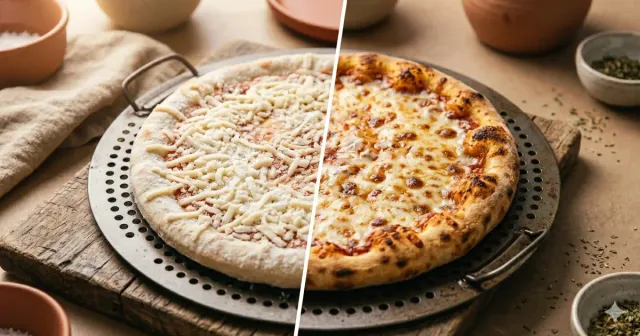 Frozen Pizza in Air Fryer Conversion
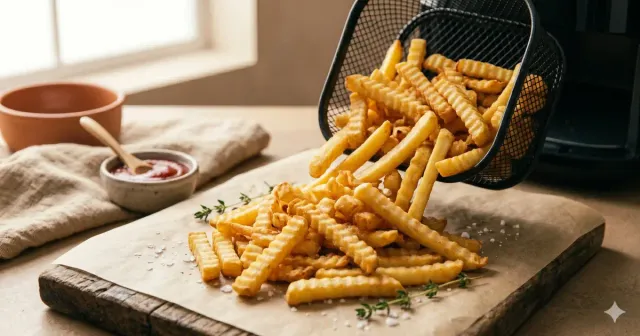 Frozen Fries: Oven to Air Fryer Conversion
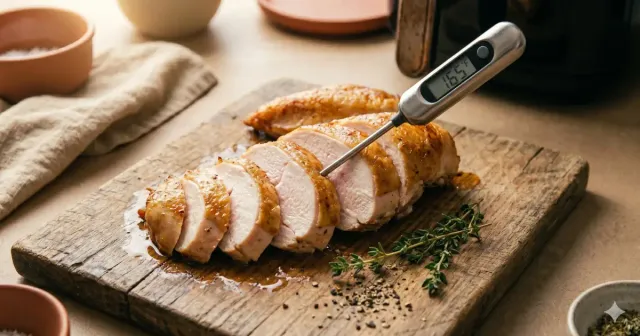 Chicken Breast Oven to Air Fryer Conversion
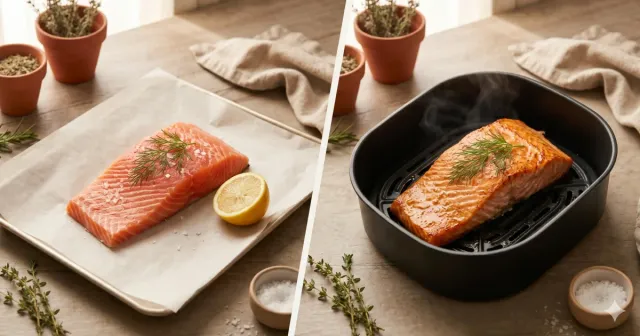 Salmon: Oven to Air Fryer Conversion
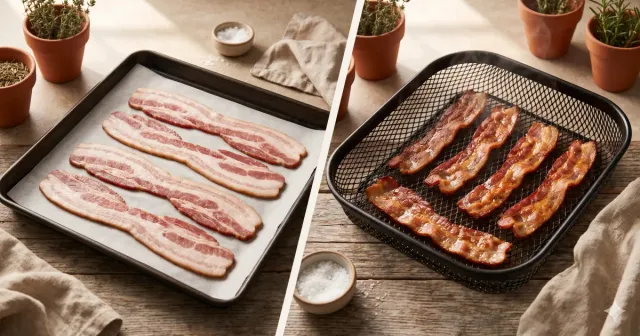 Bacon: Oven to Air Fryer Conversion
Frequently Asked Questions
Can I put aluminum foil in an air fryer?
Yes, but ensure it is weighted down so it doesn't hit the heating element, and don't block all the airflow in the basket. Most manufacturer manuals (Ninja, Cosori, Instant) explicitly permit foil under food, not loose in the basket.
Do I need to preheat my air fryer?
The manuals for both of our test machines say yes. Cosori's Pro II manual says to preheat (5 minutes at 380°F and above, 4 minutes from 340°F to 370°F, 3 minutes at 330°F and below) and that food will not cook thoroughly without it, and Ninja's AF101 guide recommends 3 minutes. Some of our food guides give times we tested from a cold basket and say so; if you preheat, check those foods 1 to 2 minutes early.
Why is my air fryer smoking?
Almost always rendered fat hitting the heating element. A tablespoon of water in the bottom tray prevents grease from burning. If smoke continues with low-fat food, check for crumb buildup on the element. That is the most common cause of persistent smoking.
Does the conversion change for convection ovens?
Yes, but less. From a fan oven (also sold as fan-assisted or convection) to an air fryer, subtract 15°F (10°C) instead of 25°F and cut the time by 10% instead of 20%: 400°F for 20 minutes becomes 385°F for 18 minutes. The convection oven already has airflow assistance, so the gap to the air fryer is smaller than from a still-air oven. Choose Fan in the converter and it applies these numbers. Choose Gas to pick a gas mark, which converts like a standard oven.
Can I convert baking recipes (cakes, cookies, brownies) the same way?
No. Baked goods need the standard 25°F drop but only a 10-15% time reduction, not 20%. Gluten and starch hydration need the full bake duration; cutting time too aggressively produces gummy centers. Verify doneness with a toothpick, not a timer.
Why is my air fryer cooking faster than the conversion suggests?
Three causes, in order of likelihood: (1) smaller chamber volume than our reference 5.8-quart, which concentrates heat, (2) higher wattage (1700W+ models run hot), (3) small batch size. A single serving cooks faster than the four-serving load these conversions are calibrated for. Always check 2-3 minutes early on a new recipe.
How does air fryer wattage affect the conversion?
1500W vs 1700W vs 1800W produces measurable differences: roughly 1 minute of cook time per 100W on a 4-quart basket. Manufacturer-published times in this guide assume the typical 1500 to 1700W range. If your appliance is at the high end, reduce time another 5-10% on the first cook.
Do these conversions work for the reverse direction (air fryer recipe to oven)?
The math runs in reverse (add 25°F and increase time by 25%, which undoes the 20% time cut), but baked goods need extra time on the oven side beyond that. We have a dedicated reverse calculator for the air-fryer-to-oven direction with worked examples.
Does this converter work for an air fryer toaster oven or air fryer oven?
Yes. Choose Oven-style in the converter. Air fryer ovens such as the Ninja Foodi Digital Air Fry Oven, Cuisinart TOA-60 and Breville Smart Oven Air Fryer take the same 25°F step as a basket (Ninja's manual gives 25°F for oven recipes on Air Roast, Cuisinart's gives 25°F for Convection Bake), but all three air fry up to 450°F (230°C), where both of our basket test units stop at 400°F. So a 450°F oven recipe becomes 425°F, and a 500°F broil recipe caps at 450°F with a pointer to the unit's own Broil setting. The time cut stays at our standard 20%, while Ninja's manual suggests 30% for oven recipes on its Air Roast setting, so check 2 to 3 minutes early. We have not cooked in an air fryer oven ourselves; these figures come from the three manuals, not our test kitchen.
Sources and references
Safety claims on this page are linked to primary sources. Conversion baselines are from manufacturer-published settings.