Easy Air Fryer Recipes for Beginners: Seven Cooks in Seven Days
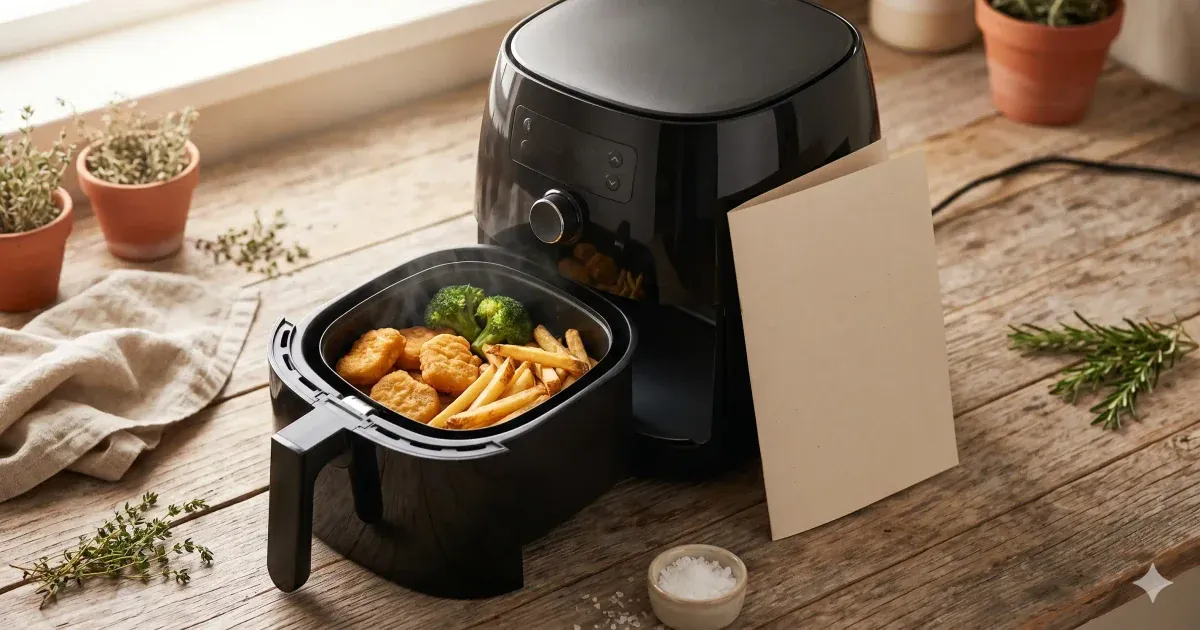
Beginner air fryer cooking works better as a sequence than as a recipe box: seven cooks, one a day, ordered so each one teaches the technique the next one needs. Every cook names the oven setting it replaces and the air fryer setting that does the same job. There is no shopping list and there are no ingredient quantities, because the order and the settings are the part that decides whether a cook lands. Most new owners skip both, attempt an ambitious dinner on night one, get one bad result, and the unit is in a cabinet by month two.
Each day teaches one technique. Day 1 covers unboxing and the universally easy first cook. Day 2 introduces the thermometer. By Day 7 you have run the seven most common air fryer workloads (frozen, fresh protein, pizza, vegetables, wings, fish, and reheating) with the exact settings that work on your unit at your altitude with your power.
Every setting printed on this page is a Cosori Pro II 5.8-qt measurement, with internal temperatures read on a calibrated ThermoWorks Thermapen ONE. The Ninja AF101 is the reference for the 4-quart capacity figures here, not for a second set of times. If your unit is a different model, the temperatures hold; the times may shift by 30 to 60 seconds based on wattage. Adjust on the second cook, not the first.
Four settings from the test kitchen
Every number in this table was measured on a Cosori Pro II 5.8-qt, with internal temperatures read on a calibrated ThermoWorks Thermapen ONE. Rows run in the order the week reaches them, Day 2 through Day 6. The oven column is the setting each food came from, so the size of the conversion is visible in one glance. Bacon sits with Day 5 because it is the cook most people try next and the one most likely to smoke.
| Food | Oven | Air fryer | Internal target |
|---|---|---|---|
| Chicken breast, 8 oz, 1.25 inch thick | 375°F / 25 min | 360°F / 18 min | 165°F (74°C), pull at 162°F |
| Chicken wings, fresh whole | 400°F / 40 min | 375°F / 22 min (flip at 11) | 165°F (74°C) |
| Bacon, standard cut | 400°F / 18 min | 380°F / 9 min | 145°F (63°C) |
| Salmon fillet, skin-on, 1 inch thick | 400°F / 13 min | 380°F / 9 min | 145°F (63°C), pull at 142°F |
All four verified on a Cosori Pro II 5.8-qt. Internal targets are USDA FSIS: 165°F for poultry, 145°F for fish, 145°F for cured pork. Dial accuracy varies by model, so on any other unit treat these as the starting point and check early on the first cook.
How to set up a new air fryer before the first cook
Setting up a new air fryer takes four steps: unpack it, wash the basket, place it, and run it empty once. A basket air fryer arrives assembled, so there is nothing to build. The Cosori Pro II manual gives the order: remove all packaging and temporary stickers, pull out the basket and any plastic inside it, separate the inner and outer baskets, and wash both in the dishwasher or with a non-abrasive sponge. Wipe the body inside and out with a damp cloth, dry it, and slide the baskets back in.
Set it on a stable, level, heat-resistant surface, away from walls and cupboards that steam could damage. Cosori asks for 5 inches (13 cm) of space behind and above the unit, plus room in front to pull the basket out.
Then run it empty. Cosori's test run is 5 minutes at 400°F, 5 minutes to cool, then 5 more minutes at 400°F, followed by a full cool of 10 to 30 minutes. If your manual gives no test run, run the empty unit at 400°F for 10 minutes in one go. A plastic smell or a little white smoke on that first run is normal, so open a window. Dark smoke is not: unplug the unit, and if burnt food was not the cause, contact the maker.
Read the rest of the manual too. Temperature range, preheat steps, basket interlocks and the MAX fill line vary by model, and where the manual disagrees with this guide about your unit, the manual wins. Preheating is one of those places. Cosori's Pro II manual says to preheat (5 minutes at 380°F and above, 4 minutes from 340°F to 370°F, 3 minutes at 330°F and below) and that food will not cook thoroughly without it, and Ninja's AF101 guide recommends 3 minutes. The fries, chicken breast, wings and bacon times on this page were measured from a cold basket, so if you preheat, check those 1 to 2 minutes early.
Find the MAX line. Cosori marks a MAX fill line inside the Pro II's inner basket and says not to fill above it or pack food in; Ninja's AF101 guide says not to overfill the basket. Neither manual gives a weight limit, so go by floor area instead: in our test cooks the 5.8-qt basket held 14 chicken wings in a single layer, not 25, and the 4-qt AF101 held 8.
Confirm the tray drains. Pour 1/4 cup of water into the empty basket. Water should pass through the perforated tray to the drip pan without pooling. A pooling tray means a defect; return the unit. The drip pan catches grease on later cooks; if it does not drain, fatty foods will smoke.
Day 1 cook: Frozen fries (the universally easy first cook)
Frozen fries are the right first cook because they are nearly impossible to fail. The factory pre-fry sets the breading; the freezer holds the surface water; the basket airflow finishes the crisp. Even a brand-new unit with calibration error of plus-or-minus 15°F produces edible fries on the first try.
Pour 12 ounces of frozen Ore-Ida Golden Crinkle into a cold basket. Set 400°F for 13 minutes, the tested crinkle-cut setting. Shake at the halfway mark. Pull at 13 minutes; if still soft in the middle, return for 90 seconds at 400°F. See the frozen fries oven-to-air-fryer guide for the per-cut chart.
Day 2: Chicken breast (introduces the thermometer)
Day 2 introduces the single most important kitchen tool the air fryer needs: an instant-read thermometer. ThermoWorks Thermapen ONE, ThermoPop, or any sub-3-second-read probe works. Owning one and using it on every protein cook matters more than the specific model.
Take a boneless skinless chicken breast. Pat dry, brush with olive oil, dust with salt and pepper. Place in a cold basket. Set 360°F: 15 minutes for a 6 ounce breast about an inch thick, 18 minutes for an 8 ounce breast closer to 1.25 inches. Flip at the halfway mark. Thickness sets the time, not weight, which is why the chart in the chicken breast oven-to-air-fryer guide is indexed by inches. Probe the thickest part, pull at 162°F, and rest five minutes; carryover brings it to the USDA FSIS target of 165°F while it sits.
Day 3: Frozen pizza (introduces size-fit constraints)
Day 3 introduces the basket-size geometry that constrains what the air fryer can cook. A round pizza is capped by the narrower dimension of the basket floor, never by its diagonal, so the Cosori Pro II 5.8-qt's 8 by 8-inch floor takes an 8-inch pizza flat and nothing wider. Turning it on an angle buys nothing: a circle does not use a corner. A 4-quart basket such as the Ninja AF101's deep oval is tighter still, already too narrow for the 6 to 7 inch round pans sold for 5.8-qt baskets, so treat 5.5 inches as its working ceiling. Never bend a frozen crust to force a fit; it cracks and sheds toppings. A cooked slice out of the fridge is pliable enough to fold, a frozen one is not. Family-size 12-inch pizzas fit no basket-style air fryer at any quart rating. The countertop ovens that take one whole are a different appliance class: Breville ships a 13-inch pizza pan with its Smart Oven Air Fryer Pro.
Pull an 8-inch frozen personal-pan pizza, or smaller if your basket is a 4-quart. Set 380°F for 8 minutes; place directly in the basket. No parchment unless cheese is heavy. Pull at 8 minutes, check that cheese is bubbling and edges are golden. If not yet melted, return for 60 seconds. Box instructions of 425°F oven for 15 minutes convert to 380°F air fryer for 8 minutes. See the frozen pizza in air fryer guide for the per-brand fit chart.
Day 4: Roasted vegetables (introduces shake-the-basket and the moisture problem)
Day 4 confronts the air fryer's hardest material: fresh vegetables with high water content. Broccoli, Brussels sprouts, peppers, and zucchini all release water during the cook, and the basket cannot drain it mid-cook the way a sheet pan does. Without intervention they steam and never crisp.
Cut 1 pound of broccoli into 1.5-inch florets. Pat dry. Wet vegetables will not crisp at any temperature. Toss with 1 tablespoon of avocado oil, salt, and garlic powder. Spread in a single layer. Set 390°F for 10 minutes. Shake at the 5-minute mark. Pull when edges are charred and centers are tender. Avocado oil works because its smoke point (520°F) sits above any air fryer setting; olive oil starts smoking at 375°F to 400°F. See why your air fryer smokes for the smoke-point reference table.
Two vegetables people search for by name sit outside the fresh list above: corn on the cob and sweet potato. The settings this kitchen has for both are for the frozen product, because frozen is what was tested. Frozen corn on the cob runs 390°F for 12 minutes with a flip at 6, against 400°F for 22 minutes in the oven. Frozen sweet potato fries run 390°F for 14 minutes with a shake at 7, against 425°F for 22 minutes. Fresh corn in the husk and a whole fresh sweet potato carry more water and take longer, and there is no measured number for either here yet.
Day 5: Wings (introduces the dry-the-skin technique)
Day 5 introduces the technique behind the food the appliance is most praised for: drying the skin hard before the wings go in. Skin out of the package carries surface moisture that steams during the early minutes and leaves the result rubbery.
Take 1.5 pounds of fresh chicken wings. Pat each piece dry. Towels should come away wet. Toss with 1 teaspoon of aluminum-free baking powder per pound, plus salt and pepper. The baking powder raises skin pH, weakens protein bonds, and lets fat render more efficiently, producing a dramatically crispier result.
Place wings in a single layer in a cold basket. Set 375°F for 22 minutes. Flip at the 11-minute mark. Pull at 22 minutes, probe internal. Must read 165°F per USDA FSIS. Optional: raise to 400°F for a final 2 to 3 minutes for glass-like skin. See the chicken wings oven-to-air-fryer guide for bone-in versus boneless variations.
Bacon is the cook most people try the week after wings, and it runs the same idea from the other side: wings need moisture driven off the skin, bacon needs the rendered fat to have somewhere to go. Standard-cut strips run 380°F for 9 minutes from cold, single layer, with 1 tablespoon of water in the drip tray. The water pins the tray surface at 212°F so dripping fat never reaches its smoke point, which is why Day 1 asked you to confirm the tray drains. The oven setting it replaces is 400°F for 18 minutes, and USDA FSIS puts cured pork at 145°F internal.
Day 6: Salmon (introduces the 145°F target)
Day 6 cooks fish, which has a different USDA-published internal target than poultry. Salmon is forgiving on time but unforgiving on temperature: 5 minutes too long at 380°F produces a dry, chalky result instead of moist, flaky texture. The thermometer earns its keep on this cook.
Take a 6 to 8 ounce skin-on salmon fillet. Pat dry, brush with olive oil, dust with salt and dill. Place skin-side down. Set 380°F for 9 minutes. Probe the thickest part at the 7-minute mark. Pull when the probe reads 145°F per USDA FSIS for fish (not 165°F, that applies to poultry only). Salmon coasts about 3°F off heat, so pull at 142°F to land at 145°F. See the salmon oven-to-air-fryer guide for the skin-crisp technique.
Day 7: Reheating leftovers (introduces the 350°F universal reheat)
Day 7 covers the air fryer's most underrated workload: reheating cooked-then-refrigerated leftovers. Microwaves steam the surface and leave it soggy. Air fryers reheat by airflow, which strips the moisture that accumulated in storage and re-crisps without overcooking the interior.
Pull a leftover slice of pizza, a piece of fried chicken, or roasted vegetables from the fridge. Place directly in the basket. No parchment unless heavily sauced. Set 350°F for 4 minutes. Probe protein items to confirm 165°F per FoodSafety.gov leftover-reheat target. If not yet hot through, return for 60 seconds. The 350°F universal reheat works because it is hot enough to drive surface moisture off but cool enough that the interior reaches reheat temperature before scorching. See how to reheat in air fryer for the per-food reheat-time table.
The 5 mistakes everyone makes in the first week
Mistake 1: Overcrowding the basket. Stacked food traps steam, blocks airflow to the bottom layer, and produces uneven results blamed on the unit. Cook in two batches. Total time is shorter than fixing a soggy first batch.
Mistake 2: Skipping the shake. Small-format frozen foods (fries, tots, popcorn chicken) need a basket shake at the halfway mark. Skip it and the bottom layer comes out soggy while the top is over-crisped.
Mistake 3: Low-smoke-point oils. Olive oil smokes at 375°F to 400°F and butter at 300°F, while air fryers run 350°F to 400°F. Use avocado (520°F), refined coconut (450°F), or refined peanut (450°F). Smoking oil is burning oil, which tastes rancid.
Mistake 4: Judging done by color. Breaded foods look brown outside while raw inside. The thermometer is the only reliable doneness indicator on protein; visual texture is the only reliable indicator on non-protein. Time and color together fail roughly 15 percent of the time.
Mistake 5: Opening the basket too often. Every pull drops chamber temperature 30 to 50°F and adds 60 to 90 seconds. Pull twice: once at halfway to shake, once at 75 percent to probe. Otherwise the basket stays closed.
What to buy in week 2
Three accessories earn their price by the end of week 1. They pay back in convenience and basket-coating life within 10 cooks.
An instant-read digital thermometer ($25 to $90). ThermoWorks Thermapen ONE is the gold standard at $89; the ThermoPop ($35) and Lavatools Javelin ($29) are the value picks. Any sub-3-second-read probe works. The first ruined chicken breast costs more than the cheapest thermometer.
Pre-perforated air fryer parchment paper ($10 to $15 for 100 sheets). It is rated to 425°F per FDA food-contact regulations and keeps sticky leaks off the coating. Skip un-perforated baking parchment: it blocks airflow and produces soggy bottoms.
A non-abrasive basket scrub brush ($8 to $15). The coating is what makes the basket non-stick, and abrasive scrubbing strips it in 50 to 100 cycles. Steel wool and the rough side of a green sponge do it in 10 to 20. See the air fryer accessories guide for FDA-cited heat ratings and warranty terms.
Frequently Asked Questions
What should I cook first in a new air fryer?
Frozen french fries. The factory pre-fry sets the breading, the freezer holds the surface water, and the basket airflow finishes the crisp. Even a brand-new unit with calibration error of plus-or-minus 15°F produces edible fries on the first try: crinkle cut at 400°F for 13 minutes, shaken at the halfway mark.
Do you need to break in a new air fryer before using it?
Yes, with an empty test run. The Cosori Pro II manual runs it in two stages (5 minutes at 400°F, 5 minutes to cool, 5 more at 400°F, then a full cool) and says it clears the plastic smell left by manufacturing. Open a window. If the smell outlasts the test run, contact the maker.
How long does it take to learn to use an air fryer?
One week of varied cooks builds the techniques that make every later cook predictable: frozen items on Day 1, protein with a thermometer on Day 2, pizza-fit constraints on Day 3, vegetables on Day 4, wings on Day 5, fish on Day 6, leftovers on Day 7. After seven days the unit is a tool you reach for without consulting a recipe.
What is the most common air fryer mistake new owners make?
Overcrowding the basket. Stacked food traps steam, blocks airflow to the bottom layer, and produces uneven results. Cook in two batches; the total time beats fixing a soggy first batch. Single layer with 1 inch of spacing is a constraint, not a guideline.
Do you need a thermometer for an air fryer?
Yes, for any protein cook. Color and timing fail at least 10 percent of the time on protein; the thermometer fails roughly never. ThermoWorks Thermapen ONE, ThermoPop, or any sub-3-second-read probe works.
Should you preheat an air fryer for the first cook?
Both of our test machines' manuals say yes. Cosori's Pro II manual says to preheat (5 minutes at 380°F and above, 4 minutes from 340°F to 370°F, 3 minutes at 330°F and below) and that food will not cook thoroughly without it, and Ninja's AF101 guide recommends 3 minutes. Our fries, chicken breast, wings and bacon times were measured from a cold basket, so if you preheat, check 1 to 2 minutes early.
What are the easiest air fryer recipes for beginners?
Frozen food first, then one fresh protein. Crinkle-cut frozen fries at 400°F for 13 minutes with a shake at the halfway mark are close to unfailable, and an 8 ounce chicken breast at 360°F for 18 minutes is the first cook that teaches the thermometer. Work up to wings on Day 5 at 375°F for 22 minutes with a flip at 11. Difficulty tracks how much water the food is carrying, not how elaborate the dish is.
Can you cook bacon in an air fryer?
Yes, and it is roughly half the oven time. Standard-cut strips take 380°F for 9 minutes from cold in a single layer, against 400°F for 18 minutes in the oven, with 1 tablespoon of water in the drip tray to keep rendered fat below its smoke point. Thick-cut takes 380°F for 12 minutes. USDA FSIS sets cured pork at 145°F internal.
Sources & references
Internal-temperature targets, leftover storage timelines, and reheat-temperature claims on this page link to primary regulator guidance. Preheat and fill-line guidance comes from the Cosori Pro II and Ninja AF101 manuals linked below. The settings table above is in-kitchen measurement, not manufacturer data.
Ninja AF101 Owner's Guide
Recommends letting the unit preheat for 3 minutes before adding ingredients and says not to overfill the basket; it gives no weight limit. Cited in Day 1 and the preheat FAQ.
USDA FSIS Safe Minimum Internal Temperature Chart
The 165°F poultry, 160°F ground beef, and 145°F fish internal-temperature targets cited in Days 2, 5, and 6, plus the 165°F leftover reheat target in Day 7.
FoodSafety.gov Leftovers and Food Safety
The 165°F internal-reheat target for cooked leftovers and the 2-hour cool-down rule before refrigeration cited in Day 7's reheating section.
Breville Smart Oven Air Fryer Pro (BOV900) product page
Manufacturer-published 1 cubic foot interior and included 13-inch pizza pan, cited for the Day 3 note on which appliance class takes a full 12-inch pizza.
Cosori Pro II 5.8-Quart (CS358-AF) User Manual
The Day 1 setup steps, 5 in / 13 cm clearance and two-stage 400°F test run, the MAX fill line, and the preheat table (5 minutes at 380°F and above, 4 minutes from 340°F to 370°F, 3 minutes at 330°F and below) with the line that food will not cook thoroughly without preheating, plus the FAQ's first-use smell and preheat notes.
Bottom Line
Seven days of sequenced cooks builds the seven techniques that cover 90 percent of air fryer cooking: frozen-direct, single-layer, shake-at-halfway, dry-the-skin, pat-dry-vegetables, probe-by-thermometer, and 350°F-universal-reheat. After week 1 the unit is a tool, not a project.
Buy the thermometer first, parchment second, scrub brush third. Skip the multi-tier racks and plastic accessories regardless of marketing claims.
The habit that takes longest to build is closing the basket and trusting the timer. Pull at halfway to shake, pull at 75 percent to probe, leave it shut the rest of the time. Every extra pull drops chamber temperature and adds about 60 seconds.