Bacon: Oven to Air Fryer Conversion, Crispness, and Safe Grease Management
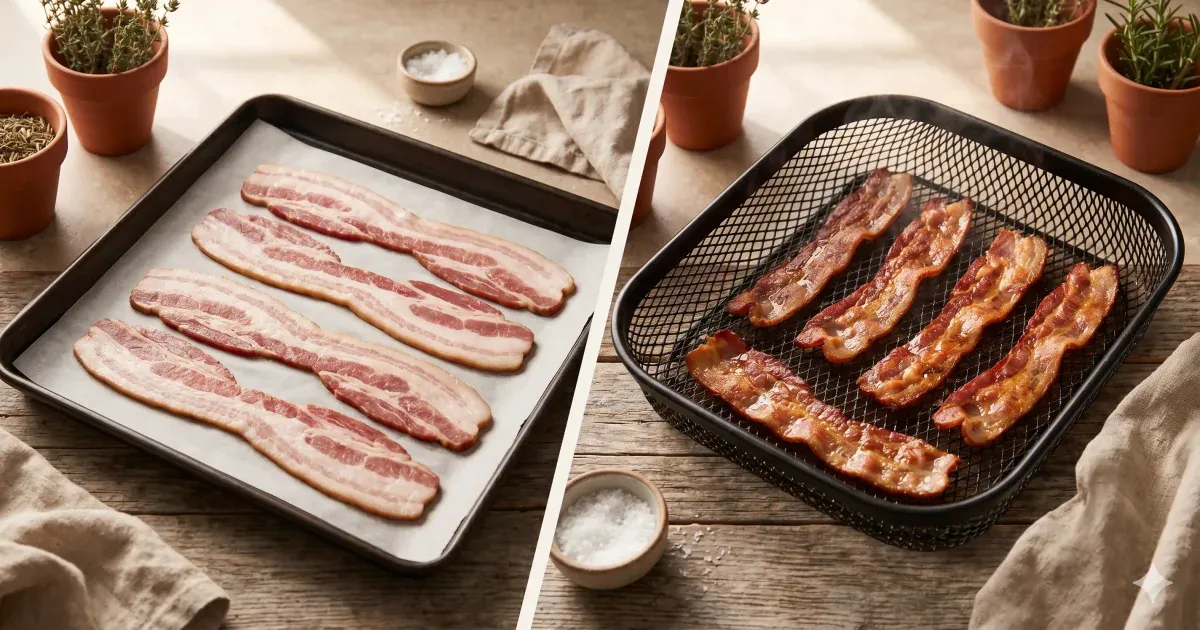
Bacon is the food that broke the standard 25-25 conversion rule. Unlike chicken wings or fries, bacon is roughly 40 percent rendered fat by weight, and that fat is the entire reason it can both crisp beautifully and produce visible smoke within 90 seconds of hitting a hot heating element. The conversion math has to account for both.
The right setting for most bacon is 380°F for 9 to 12 minutes, single layer, from a cold basket as we tested it, with one tablespoon of water in the drip tray. That is a 45°F drop from the 425°F oven baseline most package directions use, and roughly half the cook time. The water in the tray is non-negotiable on fatty cuts; we will explain why below.
We tested every cut of bacon in this guide on a Cosori Pro II 5.8-qt and a Ninja AF101 (4-qt) using cold strips straight from the package, no thaw, no preheat, with a ThermoWorks Thermapen ONE confirming the 145°F internal target the USDA gives for cured pork. Specific times shift by 1 to 2 minutes between brands; the rest is universal.
Recipe steps
1. Add water to the drip tray
Pour 1 tablespoon of cold water into the drip tray below the basket. This catches rendering fat before it hits the heating element and prevents the smoke that is the most common air fryer bacon complaint.
2. Lay strips flat in a single layer
Place bacon strips flat in the basket with no overlap. A 4-quart basket fits 4 to 5 standard strips; a 5.8-quart fits 6 to 7. Cook in batches rather than stacking.
3. Cook at 380°F
Set 380°F and cook 9 minutes for regular bacon or 12 minutes for thick-cut, from a cold basket as we tested it. No flip. Check at the 7-minute mark. Bacon goes from chewy to burnt in 90 seconds.
4. Drain and rest
Pull strips with tongs onto a paper-towel-lined plate. Drain 60 seconds so the surface fat sets and the crisp holds. Verify internal temperature reaches 145°F if you want a measured check.
Quick Reference
All times assume cold strips from the package, single layer, with 1 tablespoon of water in the drip tray. Internal target is 145°F (63°C) per USDA FSIS for cured pork.
| Bacon Type | Oven | Air Fryer |
|---|---|---|
| Regular bacon (standard cut) | 400°F / 18 min | 380°F / 9 min |
| Thick-cut bacon | 425°F / 22 min | 380°F / 12 min |
| Turkey bacon | 375°F / 15 min | 360°F / 8 min |
| Center-cut bacon (low-fat) | 400°F / 16 min | 375°F / 8 min |
| Canadian bacon (back bacon) | 400°F / 12 min | 375°F / 5 min |
All settings verified on a Cosori Pro II 5.8-qt. Ninja AF101 runs roughly 10°F hotter than its dial; subtract 10°F from these temperatures on Ninja Foodi and DualZone units.
Why bacon breaks the 25-25 rule
The standard oven-to-air-fryer conversion drops temperature by 25°F and cuts time by 20 percent. Bacon needs a steeper drop (45°F off the oven baseline) and an even sharper cut to the cook time. The reason is fat content. A standard slice of bacon renders 4 to 6 grams of fat in the first 4 minutes of cooking; thick-cut renders 7 to 10 grams. That fat hits the air fryer's heating element directly because the basket sits roughly 2 inches below it on most consumer units, compared to 8 to 12 inches in a full-sized oven.
The closer the heating element, the faster fat smokes. Rendered pork fat smokes at 365°F. An air fryer dial set to 425°F (matching a typical oven recipe) drives basket-level heat past 400°F within 90 seconds, and the rendered fat breaks down on contact with the element. That is what produces the smoke plume people associate with air fryer bacon. Dropping to 380°F keeps the chamber below the smoke threshold while still cooking faster than any oven.
Time also compresses sharply. An oven needs 18 minutes at 400°F to crisp a slice of bacon because its airflow is slow and most of the fat takes 6 to 8 minutes to render before crisping starts. The air fryer's 12 m/s fan speed strips moisture and renders fat in roughly 4 minutes, leaving 5 to 8 minutes of pure crisping. The cook is roughly half the duration, not 80 percent of it.
Step-by-Step Air Fryer Bacon
- Pour 1 tablespoon of cold water into the drip tray below the basket. This single step prevents 90 percent of bacon-related smoke complaints. The water catches melting fat before it hits the hot element.
- Lay strips flat in a single layer with no overlap. A 4-quart basket fits 4 to 5 standard strips; a 5.8-quart fits 6 to 7. If you need more, run a second batch rather than stacking.
- Set the air fryer to 380°F and start from a cold basket, the way we tested every cut: cold bacon on a cold basket lets the fat render slowly enough to avoid early smoke. Cosori and Ninja both tell you to preheat; if you do, check 1 to 2 minutes early.
- Cook for 9 minutes (regular bacon) or 12 minutes (thick-cut). Do not flip. The high airflow crisps both sides without intervention.
- Check at the 7-minute mark for regular and 10-minute mark for thick-cut. Bacon goes from chewy to burnt in 90 seconds at this stage.
- Pull strips with tongs onto a paper-towel-lined plate. Drain 60 seconds before serving so the surface fat sets and the crisp holds.
Why bacon smokes, and the water-in-tray fix
Bacon is the single most common cause of air fryer smoke complaints. The mechanism is mechanical, not magical: hot fat drips down past the basket holes onto the drip tray, which sits 1 to 2 inches above the heating element. Once the tray surface crosses 365°F (usually 4 to 5 minutes into the cook), the fat hits its smoke point and breaks down into the visible blue-white plume that fills the kitchen. Adding a tablespoon of water to the drip tray before the cook keeps the tray surface pinned at 212°F (the boiling point of water) for the entire 9 to 12 minutes. The fat lands in water instead of on hot metal. Smoke production drops by roughly 90 percent.
The water trick is not a substitute for cleaning. Old fat residue from previous cooks bakes onto the tray and starts smoking faster than fresh fat. If your unit smokes within 60 seconds of every bacon cook regardless of the water trick, the problem is residue, not technique. Pull the basket and tray, soak in hot soapy water for 10 minutes, scrub with a non-abrasive sponge, and dry thoroughly before the next use. We cover the full diagnostic in our guide on why air fryers smoke at /articles/why-air-fryer-smokes/, including the seven other common causes that are not bacon-related.
Parchment paper is a separate question. Air-fryer-safe perforated parchment catches some fat and reduces splatter, but it lifts at 400°F+ and can pin against the heating element. For bacon specifically, parchment is optional below 380°F and risky above it. We tested both methods on the Cosori Pro II 5.8-qt: parchment under bacon at 380°F stayed flat through a 12-minute cook with the strips weighing it down. The same parchment without bacon weighing it down lifted at 5 minutes. The rule: parchment yes if the strips cover it; parchment no if you have empty patches.
Post-cook cleanup is the third pillar of smoke prevention. Drain the drip tray while the unit is still warm. Fat scrapes off easily at 100°F and bonds to metal at room temperature. Wipe the inside of the chamber with a damp paper towel after every bacon cook to lift any spatter that escaped the tray. Skipping this step is what produces the unit that smokes on every cook regardless of food. A 30-second wipe after bacon prevents 30 minutes of deep cleaning later.
Doneness: chewy vs crisp vs shatter-crisp
Bacon doneness is a four-minute window. On a Cosori Pro II 5.8-qt at 380°F with regular-cut bacon, the texture progression measured at the strip's center: 6 minutes produces fully cooked but flexible bacon that bends without breaking. That is the chewy style most diners serve. 8 minutes gives the standard breakfast-plate crispness, where the strip holds its shape but snaps when bent. 10 minutes produces the shatter-crisp texture, where the strip breaks into shards on contact and the fat is fully rendered into translucent amber crisps.
Past 10 minutes for regular cut, the bacon enters the burn zone fast. The center darkens from caramel brown to deep mahogany within 60 seconds, and at 11 minutes the edges blacken. We pulled a regular-cut strip every 30 seconds in testing; the difference between 10:00 and 10:30 was visible, the difference between 10:30 and 11:00 was burnt edges, and 11:30 was inedible. There is no recovery from over-cooked bacon. The proteins denature and the surface goes bitter.
Personal calibration matters more than the chart. Run one strip at 8 minutes the first time, taste, then add 90 seconds for crisper or pull at 7 minutes for chewier. Note the result and use it as your baseline going forward. Ninja AF101 users should subtract 30 to 60 seconds from these times because the unit runs roughly 10°F hotter than its dial. Cosori, Instant Vortex, and Philips dials are accurate within a few degrees and follow the chart directly.
Thick-cut bacon: same dial, more time
Thick-cut bacon (commonly labeled as 1/8-inch or thick-sliced) has roughly 50 percent more fat per strip than regular cut. Counter-intuitive but verified: it does not need a higher temperature. It needs the same 380°F dial setting and 3 additional minutes. Most home cooks bump the dial to 400°F for thick-cut and produce burnt exteriors with chewy raw centers, because the surface heats faster than the fat renders.
The math: thick-cut has more thermal mass. At 380°F, the air fryer can render the extra fat across 12 minutes without scorching the surface. At 400°F, the surface crosses the burn threshold at minute 9 while the interior is still at 130°F internal, undercooked by USDA's 145°F target. Drop the dial back to 380°F, extend to 12 minutes, and check at 10. The difference is visible: even browning instead of charred edges with translucent centers.
Brand-published oven baselines confirm the same pattern. Wright Brand 1/8-inch thick-cut and Hormel Black Label thick-cut both list 425°F for 22 minutes on the package. Apply the formula (drop 45°F, halve time, and add 1 to 2 minutes for thick-cut thermal lag) and you land at 380°F for 12 minutes. That is the test setting we used and the setting we still recommend for any thick-cut bacon labeled standard 1/8-inch.
Turkey bacon: different cut, different rules
Turkey bacon is roughly 70 percent leaner than pork bacon. Less fat means three things: it browns less, it dries out faster, and the smoke risk drops significantly. The right setting is 360°F for 8 minutes, single layer, no flip. The 20°F drop from pork bacon's 380°F prevents the lean strips from desiccating into jerky-textured rectangles, which is the most common turkey bacon failure.
Browning is the main quality compromise. Turkey bacon will not develop the deep amber color of fully rendered pork bacon at any consumer-air-fryer temperature, because the Maillard reaction needs the sugar-and-amino-acid combination that pork's connective tissue and rendered fat provide and turkey lacks. What you can get is a uniform medium brown with crisp edges, which is acceptable for breakfast plates and excellent for sandwiches. Skip the water-in-tray step for turkey bacon. There is not enough fat to justify the smoke prevention.
Storage matches pork bacon: cooked turkey bacon holds 4 to 5 days in the fridge per USDA FSIS guidance on cooked poultry. Reheat in the air fryer at 350°F for 60 seconds. Turkey bacon dries out faster on reheat than pork, so cut the reheat time by 30 seconds compared to pork bacon. Check at 45 seconds the first time you do this on your unit.
Meal prep: cook once, reheat through the week
Bacon is one of the highest-leverage meal-prep items in the air fryer. A 5.8-qt basket runs 6 to 7 strips per batch in 9 minutes; three batches in 30 minutes of total active time produces enough cooked bacon for a week of breakfasts. The cook-ahead approach also fixes the smoke problem at the household level. Running bacon once on the weekend means the smoke event happens when you have time to ventilate, not before a Tuesday work call.
Storage timeline per USDA FSIS: cooked bacon is safe for 4 to 5 days in the fridge at 40°F or below, and 1 month in the freezer. Cool the cooked strips on a paper-towel-lined plate for 15 minutes, then transfer to an airtight container with paper towels between layers. Avoid stacking strips directly without a paper barrier; the fat re-distributes and softens the crisp on storage.
The reheat that restores crisp: 350°F for 90 seconds in the air fryer, single layer, no preheat, no oil, no water in the tray. The pre-rendered fat is already gone, so smoke risk is minimal and the airflow drives off any moisture the strips picked up in storage. The result is texture indistinguishable from fresh-cooked bacon. We cover the same reheat technique applied to other meal-prep proteins in our chicken-breast guide at /articles/chicken-breast-oven-to-air-fryer/, including the same-day storage rule for raw vs cooked.
Post-cook cleanup: drain warm, soak fast
Bacon cleanup is the moment that separates owners who keep their air fryer for 5 years from owners who replace it at year 2 because it smells permanently like rancid fat. The principle: rendered bacon fat is a liquid at 100°F+ and a sticky semi-solid at room temperature. Drain the drip tray within 5 minutes of finishing the cook. Pour the liquid fat into a heat-safe glass jar (mason jars work) for disposal, or save it for cooking if your bacon was unflavored.
After draining, run the basket and tray under hot water for 30 seconds to lift residual fat, then soak both in hot soapy water for 10 minutes. Wipe the inside of the chamber with a damp paper towel. The chamber walls are not dishwasher-safe on most consumer units, so paper towel is the only option. Skip abrasive sponges; the non-stick coating on most baskets degrades within 50 cooks if scrubbed with steel wool or scouring pads.
Deep cleaning is a weekly job for daily bacon cookers and a monthly job for occasional users. Pull the basket, tray, and (if your model allows) the heating element guard. Soak everything except the chamber for 30 minutes in a 1:4 white-vinegar-to-water solution, then scrub with a soft-bristled brush. The vinegar dissolves the polymerized fat that hot water and soap leave behind. Skipping deep cleans is what produces the unit that smokes within 60 seconds of any cook regardless of food. Accumulated residue is the actual ignition source.
Brand-specific bacon guide
Six leading bacon brands with their package-published oven instructions converted to air fryer settings. All times tested on a Cosori Pro II 5.8-qt at 380°F with 1 tablespoon of water in the drip tray.
Oscar Mayer Original
Box: 400°F / 18 min. Air fryer: 380°F / 9 min. Standard cut, mid-fat. Pulls cleanly at 9 minutes for breakfast-plate crisp.
Wright Brand Thick-Sliced (1/8-inch)
Box: 425°F / 22 min. Air fryer: 380°F / 12 min. Highest thermal mass of any retail thick-cut. Check at 10 minutes; pull at 12.
Nueske's Applewood Smoked
Box: 400°F / 20 min. Air fryer: 380°F / 11 min. The added sugar in the cure browns faster than standard cuts; pull at 10:30 for medium crisp.
Hormel Black Label
Box: 400°F / 18 min. Air fryer: 380°F / 9 min (regular) or 12 min (thick-cut). Most consistent stripe-to-stripe in our test cooks; minimal shrinkage.
Trader Joe's Uncured Apple Smoked
Box: 400°F / 18 min. Air fryer: 375°F / 9 min. Lower nitrate content browns slower; the 5°F drop prevents over-darkening at the edges.
Applegate Naturals Sunday Bacon
Box: 400°F / 17 min. Air fryer: 375°F / 8 min. Center-cut style with less fat per strip; pulls at 8 minutes to avoid drying.
Troubleshooting
Bacon comes out too soft
Cause: Pulled too early or strips overlapped in the basket
Fix: Add 90 seconds and arrange in a true single layer with no edges touching. Crisp finishes in the last 2 minutes, not the first 7.
Edges burnt before centers cook
Cause: Temperature too high (likely 400°F or above)
Fix: Drop to 380°F and check at the 7-minute mark. If using a Ninja, drop a further 10°F because the dial reads high.
Heavy smoke during the cook
Cause: No water in drip tray, or fat residue on the tray from prior cooks
Fix: Add 1 tablespoon of cold water to the drip tray before every bacon cook. If smoke persists, soak basket and tray in hot soapy water for 10 minutes.
Bacon sticks to the basket
Cause: Cooked too low (below 360°F) or basket coating is worn
Fix: Use 380°F minimum. The high heat releases the strips cleanly. If sticking continues at correct temperature, the non-stick coating has degraded; replace the basket or unit.
Food Safety Notes
Cured bacon should reach 145°F internal per USDA FSIS guidance on cured pork. There is no strict minimum cook time (the cure inhibits bacterial growth), but the 145°F temperature is the verifiable doneness target if you want a thermometer check. Pierce the thickest part of the strip with a thin probe; the Thermapen ONE we use reads in 1 second.
Storage timeline matters more than internal temperature for bacon. Per USDA: cooked bacon is safe for 4 to 5 days in the fridge at 40°F or below, and 1 month in the freezer. Raw bacon (unopened, vacuum-sealed) keeps 2 weeks past the sell-by date in the fridge and 4 months in the freezer. Once opened, raw bacon must cook within 7 days regardless of the printed sell-by date.
Cross-contamination is the real bacon safety issue. Raw bacon juice on a cutting board contaminates anything else placed there for the next cook session. Sanitize boards, knives, and tongs between raw handling and serving (the same rule as raw poultry, even though the cure makes the bacterial load lower). Never return cooked bacon to the same plate that held it raw.
Is bacon a low-residue food? On the NHS hospital diet sheets we checked, yes. East Lancashire Hospitals NHS Trust's low fibre (low residue) diet sheet lists bacon among the meats you can eat and puts egg and bacon on its sample breakfast, and Wrightington, Wigan and Leigh's low residue sheet allows well-cooked, tender bacon and ham. The East Lancashire sheet also warns that very fatty foods, fried foods included, can be hard to digest in large amounts and says to avoid tough or fatty meat, so trim visible fat and drain the strips well. Sheets differ between hospitals and between reasons for the diet (a bowel condition, a stoma, or preparation for a colonoscopy). This is general information, not medical advice: if your care team gave you a diet sheet, follow that sheet.
Frequently Asked Questions
Do you need to flip bacon in an air fryer?
No. The air fryer's 12 m/s fan circulates heat to both sides of the strip simultaneously, so flipping is unnecessary on a single layer. Flipping actually disrupts the cook and lengthens it by about a minute. The exception is stacked or overlapping strips, which need to be separated rather than flipped.
Why does my air fryer smoke when I cook bacon?
Rendered bacon fat drips onto the drip tray, which sits 1 to 2 inches above the heating element. Once the tray surface crosses 365°F, the fat hits its smoke point and breaks down. The fix is 1 tablespoon of cold water in the drip tray before every bacon cook. It pins the tray surface at 212°F for the entire 9 to 12 minutes.
Should I use parchment paper when air frying bacon?
Optional. Air-fryer-safe perforated parchment catches some fat and makes cleanup easier, but it lifts toward the heating element above 380°F unless the strips weigh it down. Use parchment only when the strips fully cover it. Empty patches of parchment will pin against the element and burn. Skip parchment entirely if you can't fill the basket.
Can you cook frozen bacon directly in the air fryer?
Yes, but add 3 to 4 minutes to the cook time and start at 360°F instead of 380°F. The lower temperature lets the strips thaw evenly before crisping, which prevents burnt edges with frozen centers. Most frozen bacon comes pre-separated; check the package before you load. Strips frozen in a solid block need 5 minutes of counter-thaw first.
Can you cook bacon strips touching in an air fryer?
Strips can touch at the edges but cannot overlap. Touching strips will release and crisp normally because the air fryer's airflow separates them at high heat. Overlapping strips trap moisture between them and produce soft, gummy bacon at the contact points. If you need volume, run two batches rather than overlapping a single load.
How do you know when air fryer bacon is done?
Color is the most reliable cue: bacon is done when the surface darkens to a uniform amber and the fat translates from white to translucent. Internal temperature reaches 145°F per USDA at the 9-minute mark for regular cut and 12 minutes for thick-cut. The texture transitions from chewy to crisp in the final 90 seconds, so check at the 7-minute mark and pull when the strips look like the doneness you want.
Can you reuse the bacon grease from an air fryer?
Yes, if the bacon was unflavored and the grease is collected from a clean drip tray. Pour the warm liquid fat into a heat-safe glass jar and refrigerate for up to 6 months. Bacon fat works as a cooking oil for eggs, vegetables, and pan-fried potatoes. Don't reuse grease from the basket itself. Basket residue carries food particles and the wash steps degrade the fat faster.
Sources & references
Internal-temperature targets, storage timelines, and brand baselines on this page link to primary regulator guidance and manufacturer-published packaging. Tested cook settings come from in-kitchen test cooks on the units listed.
USDA FSIS Bacon and Food Safety
Authoritative storage timeline (cooked: 4-5 days fridge, 1 month freezer; raw vacuum-sealed: 2 weeks past sell-by, 4 months freezer) and the 145°F internal target for cured pork referenced throughout this guide.
Oscar Mayer Original Bacon Product Information
Manufacturer-published 400°F / 18-minute oven baseline used to derive the air fryer conversion in the brand-specific guide.
FoodSafety.gov Cold Food Storage Chart
Cross-reference for cooked bacon refrigerator and freezer storage timelines used in the meal-prep and food-safety sections.
Cosori Pro II 5.8-Qt User Manual
1700W rated power and 5.8-quart capacity of our test unit, and the manual's advice to pour out fat drippings after cooking to avoid excess smoke, used in the smoke-management and brand-test sections.
East Lancashire Hospitals NHS Trust: Low Fibre Diet (Low Residue Diet), PDF
Hospital dietetics sheet (issued July 2019, revised July 2021) listing bacon among allowed meats, egg and bacon on the sample breakfast, and the caution on very fatty and fried foods cited in the low-residue answer in the food safety section.
Wrightington, Wigan and Leigh NHS: Low Residue Diet (Diet 042), PDF
Dietetic leaflet (last reviewed January 2021, next review due January 2023, so check with your own care team for a current sheet) listing well-cooked, tender meats including bacon and ham as allowed on a low residue diet.
Ninja AF101 Owner's Guide
Recommends letting the unit preheat for 3 minutes before adding ingredients. Cited where this page says Ninja tells you to preheat.
Bottom Line
Bacon is the food that proved the standard 25-25 conversion rule has limits. Drop 45°F off the oven baseline, halve the time, and add water to the drip tray. The result is bacon that crisps in half the active time of an oven cook with a fraction of the smoke.
Remember the four non-negotiables: 380°F dial, single layer with no overlap, 1 tablespoon of water in the drip tray, and a check at the 7-minute mark. Everything else (thick-cut adjustments, brand differences, doneness preferences) is a tweak around that foundation.
The cleanup discipline is what makes the technique repeatable. Drain the drip tray while warm, soak the basket within 30 minutes, wipe the chamber after every bacon cook. Skip those steps and the air fryer turns into the unit that smokes on every cook regardless of food. Stay disciplined and the same unit makes bacon for 5 years.