Ninja
Ninja Crispi Portable Glass Air Fryer
- Capacity
- 4 qt
- Temperature
- Not stated
- Power
- 1500 W
Manufacturer list price $179.99, read October 17, 2026
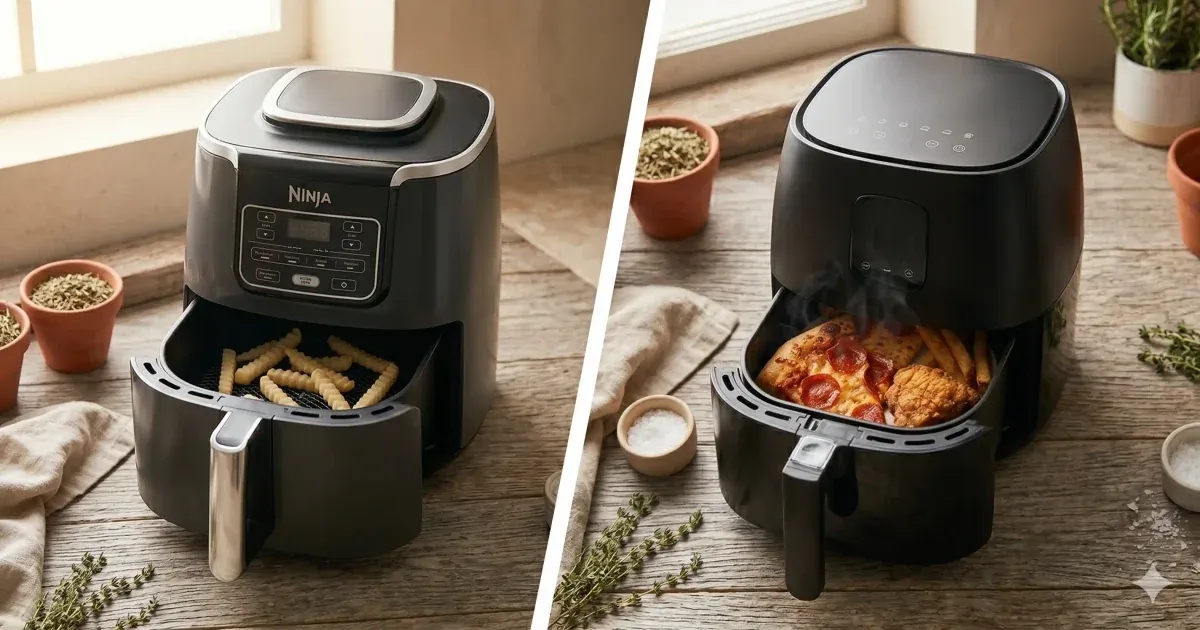
Ninja and Cosori are two of the best-selling air fryer brands in North America, and the buying decision usually comes down to a handful of measurable differences. Wattage, basket geometry, fan profile, app integration, and price-to-value spread the two lines further apart than the marketing copy implies.
This comparison is built around the units most kitchens actually buy, and the specification matrix below covers nine of them: the Ninja AF101, AF161 Max XL, DZ201 Foodi DualZone and Crispi, and the Cosori Pro II 5.8-qt, Pro LE 5.0-qt, TurboBlaze 6.0-qt, Dual Blaze 6.8-qt and TwinFry 9-qt. Every figure in that matrix comes from the manufacturer's own page or manual, linked from its row, and a field no manufacturer publishes reads Not stated rather than carrying a number we guessed. Behavioral notes are from our test cooks on the Ninja AF101 and the Cosori Pro II 5.8-qt. The recalled Cosori Original 5.8-qt (CP158-AF) is covered in the recall section below and is deliberately kept out of the matrix, because that table exists to help you choose what to buy.
The two brands solve different problems, so the quick verdict directly below answers the question by buyer type. The full verdict at the bottom of this page names a winner for each use case: small kitchens, batch cooking, digital UX, and temperature range.
Cosori is the better buy for batch cooking in one basket, and Ninja is the better buy for one or two people: in our side-by-side cooks the Cosori Pro II 5.8-qt single-layered 14 wings to the Ninja AF101's 8, and the AF101 reached the same crisp 2 minutes sooner.
For two foods at once, pick a two-zone unit such as the Ninja DZ201 or the Cosori TwinFry 9-qt, and for app control or a wider temperature range pick Cosori, since no Ninja model here has Wi-Fi and the TwinFry 9-qt runs from 95°F to 465°F. The AF101, the DZ201, and the Pro II are discontinued by their makers but still sold by retailers.
Links marked Ad earn us a commission if you buy after following one, at no extra cost to you. Commissions never decide what we recommend, and every price shown is the manufacturer's list price. How these links work
Pick any two models to see their published specifications side by side. Every figure comes from the manufacturer's own page or manual.
Ninja Air Fryer AF101No longer sold by the manufacturer | Cosori Pro II 5.8-Quart Smart Air FryerNo longer sold by the manufacturer | |
|---|---|---|
| Basket capacity (qt) | 4 | 5.8 |
| Wattage (W) | 1550 | 1700 |
| Temperature range (F) | 105 to 400 | 170 to 400 |
| Baskets | 1 | 1 |
| Presets | 4 | 12 |
| App control | No | Yes |
| Dishwasher-safe basket | Yes | Yes |
| Manufacturer price | Not stated | Not stated |
Ninja Air Fryer AF101
The AF101 is a 4-quart, 1550-watt single basket, tied with the Crispi for the smallest capacity here, and the one most single-person kitchens actually want. Four functions, a ceramic-coated basket that goes in the dishwasher, and a temperature range from 105°F for dehydrating up to 400°F.
For one or two people who want a 4-quart basket and the crispest small batches.
Cosori Pro II 5.8-Quart Smart Air Fryer
The Pro II is the 5.8-quart square-basket Cosori this comparison tests against the Ninja AF101, running 1700 watts across 12 presets from 170°F to 400°F. It shares VeSync app control and Alexa or Google Assistant voice control only with the Dual Blaze 6.8-qt, which Cosori still sells.
For households that batch-cook flat loads and want app and voice control on top.
Specifications from manufacturer pages and manuals, verified September 10, 2026, with prices rechecked October 17, 2026. A field the manufacturer does not publish reads Not stated.
These are the models in this comparison that their makers still sell. Each card repeats the capacity, temperature range and wattage its maker publishes, and the manufacturer's list price on the day we read it; Amazon sets its own price, which is often lower and changes daily. The four discontinued models have no card, because their listings are third-party or used stock.
Ninja
Manufacturer list price $179.99, read October 17, 2026
Cosori
Manufacturer list price $99.99, read October 17, 2026
Cosori
Manufacturer list price $119.99, read October 17, 2026
Cosori
Manufacturer list price $129.00, read October 17, 2026
Cosori
Manufacturer list price $179.99, read October 17, 2026
The single biggest day-to-day difference is the basket geometry. Cosori uses a square-style basket on the 5.8-qt Pro II and the 5.0-qt Pro LE, which gives a flatter, wider cooking surface. Ninja's AF101 and AF161 use a deeper, narrower oval basket, and the DZ201 splits 8 quarts into two independent 4-quart drawers.
For a single layer of wings, fries, or an 8-inch frozen pizza, the square Cosori basket fits more food without stacking. For smaller loads where spread matters less than concentrated airflow (small batches of nuggets, single chicken breasts, reheated leftovers), the Ninja's deeper oval traps heat more aggressively and finishes faster.
Counter footprint matters too. The Cosori Pro II 5.8-qt takes about the same counter area as the 4-quart Ninja AF101 (13.9 by 11.8 inches against 11 by 14), and the Pro LE 5.0-qt takes less than either at 10.7 by 10.8 inches. The Ninja Crispi has the smallest published footprint here (9.76 by 11.5 inches). The two-basket Ninja DZ201 and Cosori TwinFry 9-qt take the most counter, and the DZ201 also needs serious clearance for its rear vent.
AF101: 4-qt deep oval, single basket. AF161: 5.5-qt oval. DZ201: sold as an 8-qt unit, split into two independent 4-qt drawers. SharkNinja does not state a capacity figure in its own documentation for this model, so the specification matrix below leaves it unstated rather than repeating the number off the box.
Pro II 5.8-qt: square basket, 8 by 8-inch usable surface. Pro LE 5.0-qt: square basket. Original 5.8-qt (CP158-AF): round basket (older form factor), and on the CPSC recall list covered below.
Wattage maps directly to how fast the chamber reaches target temperature and how aggressively the heating element compensates for door openings. Cosori publishes 1700W on the Pro II 5.8-qt. Ninja publishes 1550W on the AF101 4-qt and 1750W on the AF161 Max XL. The DZ201 dual-basket sits at 1690W combined.
The practical difference verified in our test cooks: from a cold start, the Cosori Pro II 5.8-qt takes roughly 90 seconds of measured time to reach a 400°F setting; the Ninja AF101 takes about 75 seconds because the smaller chamber has less air to heat. Both makers still tell you to preheat before food goes in. Cosori's manual runs a 5-minute Preheat program at 380°F and above (4 minutes from 340°F to 370°F) and says food will not cook thoroughly without it; Ninja's AF101 guide recommends 3 minutes. Those are routines to follow before you load food, not measurements of how fast the chamber gets hot. Where our guides give times tested from a cold basket, they say so; if you preheat, check 1 to 2 minutes early.
Where the difference shows up more is recovery after a basket pull. Open the Cosori at the halfway mark to flip wings and the temperature drops about 30°F; recovery to setpoint takes 45 seconds. The Ninja AF101 drops about 20°F and recovers in 25 seconds. The smaller chamber is a real advantage for foods that need frequent checks.
Cosori's Pro II 5.8-qt uses a single high-RPM fan; Ninja's AF101 uses a similar single-fan layout, while the DZ201 has two independent fans, one per zone. None of these brands publish official decibel ratings.
Consumer Reports' published air fryer test methodology measures peak operating noise in a sound-treated lab; their reported range across consumer air fryers is 40 to 60 dBA, comparable to the range from a quiet office to a restaurant conversation. Both are louder than a microwave, quieter than a vacuum.
Subjectively in our test cooks: the Ninja AF101's pitch is higher and more focused, which can be more noticeable in a small open kitchen. The Cosori Pro II 5.8-qt has a lower-frequency hum that fades into background noise faster. Neither is what most people would call quiet.
Verified in our test cooks on the AF101 vs the Cosori Pro II 5.8-qt, with identical inputs (1.5 lb fresh chicken wings, baking-powder dusted, 375°F target, single layer, flipped at the halfway mark):
The Ninja AF101 produced visibly crispier skin in 22 minutes; the Cosori Pro II 5.8-qt needed 24 minutes for equivalent crisp because the wider basket spread the wings further from the heating element. Both hit 165°F internal verified with a ThermoWorks Thermapen ONE. Eight wings comfortably fit the AF101's 4-qt, so the 1.5 lb load ran as two batches there; the Cosori Pro II's square basket held all 14 in a true single layer.
For frozen fries (1 lb Ore-Ida shoestring at 400°F), the Cosori Pro II won outright on evenness: 14 minutes with a single shake, no soft spots. The AF101 needed two shakes in 13 minutes and produced one or two pale fries every batch. The square basket geometry simply distributes airflow more evenly across a flat load.
For an 8-inch frozen pizza, only the Cosori Pro II fit, flat and whole. The AF101 could not take it, and halving does not rescue it: cutting a round pizza through the center leaves the full 8-inch diameter as a straight edge, so the piece is exactly as wide as it was. Round pizza is the wrong food for a deep oval basket. Smaller wedges may fit, but we have not measured the AF101's narrow axis and will not guess at it; what we do know is that the 6 to 7 inch round pans sold for 5.8-qt baskets are too wide for it. The DZ201's two 4-qt drawers have the same shape problem, one per side.
Cosori's Pro II and Pro LE ship with a square dishwasher-safe basket and crisper plate. Aftermarket accessories (silicone liners, cake pans, skewer racks) are widely available in the square 8-inch form factor. The Original 5.8-qt's round basket has a smaller third-party accessory market.
Ninja's baskets are ceramic-coated nonstick on the AF101, AF161, and newer DZ201 revisions. All are dishwasher-safe per Ninja's owner manual. The oval shape limits aftermarket pan compatibility: the 6 to 7 inch round pans sold for 5.8-qt baskets are too wide for the AF101's 4-qt, and most square accessories do not fit it either.
If you plan to bake (cakes, breads, casseroles) in the air fryer, the Cosori square basket is meaningfully more versatile. If you only ever cook proteins and frozen items, the basket shape barely matters.
Two Cosori models in this comparison ship with Wi-Fi and the VeSync app: the Dual Blaze 6.8-qt, which Cosori still sells, and the Pro II 5.8-qt, which it has discontinued. The app stores presets, pushes recipes, and supports Alexa and Google Assistant voice control. The Pro LE 5.0-qt is dial-only, no app, and the TurboBlaze 6.0-qt and TwinFry 9-qt have no app either. The Original 5.8-qt is also dial-only.
Ninja's AF101, AF161, and DZ201 are all dial-and-button only, and the Crispi has no app either. Ninja does not ship a connected air fryer in this segment; the connected Foodi line is a different product category (multi-cookers).
Honest framing: the app is useful if you bake or run multi-stage cooks where remembering temperature and time matters. For the 90 percent of users who cook frozen items and a few proteins, the app is largely cosmetic. Voice control through Alexa is genuinely convenient if your hands are wet from prep.
Air fryer energy draw is a function of wattage and runtime. The Cosori Pro II 5.8-qt at 1700W running 20 minutes uses about 0.57 kWh; at the US residential average of 18.3 cents per kWh (EIA, June 2026) that is roughly 10 cents per cook. The Ninja AF101 at 1550W running the same 20 minutes uses about 0.52 kWh, or about 9 cents per cook.
Compared to a conventional oven (typically 2400W with full preheat on a 30-minute cook), both air fryers cut energy per cook by roughly half on small to medium batches. Neither brand is meaningfully more efficient than the other; chamber size is the variable that drives total energy.
Cycling matters more than raw wattage. The Ninja AF101 reaches setpoint faster and cycles its element less aggressively on a sustained 22-minute wing cook, so its real-world energy use trends lower than the Pro II 5.8-qt on top of its lower nameplate wattage.
Price is the one spec on this page we will not print in prose, because it moves faster than we can update it and because half these models no longer have a manufacturer price at all. The specification matrix further down this page carries manufacturer MSRP where the manufacturer still publishes one, and reads "Not stated" where it does not. Four of the models here are discontinued: the Ninja AF101, the AF161 Max XL, the DZ201 and the Cosori Pro II 5.8-qt are all still widely sold through retailers and still worth buying, but neither SharkNinja nor Cosori lists a price for them anymore, so any figure we quoted would be a retailer's number rather than the maker's.
Compare the specifications rather than the stickers. The Cosori Pro LE 5.0-qt reaches 450°F against the AF101's 400°F and gives you a square basket in a smaller counter footprint (10.7 by 10.8 inches against 11 by 14), which is a real difference that survives every price change. Among the models that still carry a manufacturer price, the Pro LE is the lowest and the Cosori TwinFry 9-qt and the Ninja Crispi are the highest, and those two carry the same manufacturer price as each other. The Cosori Original 5.8-qt still turns up cheap secondhand and we do not recommend it at any price: it is on the CPSC recall covered below.
Honest framing on durability: the Cosori Pro II carries a 2-year limited warranty, per its manual, and the Ninja AF101 a 1-year limited warranty, per Ninja's FAQ and owner's guide. Owner reviews regularly report that Cosori's app-connected models lose Wi-Fi pairing after firmware updates; Ninja's mechanical-control models have fewer reported failure modes simply because there are fewer parts to break. Neither brand is meaningfully more reliable than the other on the dial-only models.
Cosori carries the recall history here, and it is a large one. On February 23, 2023 the U.S. Consumer Product Safety Commission announced recall 23-130: about 2 million Cosori air fryers in the United States, plus roughly 250,000 in Canada and 21,000 in Mexico, recalled by Atekcity because a wire connection inside the unit can overheat, posing fire and burn hazards. CPSC logged 205 reports of the air fryers catching fire, burning, melting, overheating or smoking, including 10 reports of minor burn injuries and 23 reports of minor property damage. The recalled units are 3.7-qt and 5.8-qt models sold from June 2018 through December 2022 for between $70 and $130.
CPSC names 21 model numbers. They are grouped below by model family, so find your prefix first, then match the rest of the string character for character.
CP158-AF series (4)
CAF-P581 series (3)
CP137-AF series (4)
CS158-AF series (3)
CAF-P581S series (3)
CO series (3)
CP258-AF (1)
Read that list against the label on your own machine, not against a product name. The model number is printed on a label on the bottom of the unit, and Cosori's naming is close enough to catch people out: CS158-AF is on the list above, while the Cosori Pro II's own manual gives its model line as CS358-AF, one character apart. The Cosori Original 5.8-qt is CP158-AF, which is on the list, and we do not recommend buying it secondhand at any price. Neither the Cosori Pro II 5.8-qt nor the Cosori Pro LE 5.0-qt (CAF-L501-KUS) appears anywhere on the CPSC list, and neither does any Ninja air fryer. If the number on your label is on the list, stop using the unit whatever the box called it.
Checking your own unit takes a minute, and CPSC identifies the recalled air fryers by model number rather than serial number. The model number is printed on the bottom label of each unit and on the user manual. Match that string against the list above. If it matches, CPSC's instruction is to stop using the air fryer immediately and contact Cosori for a free replacement air fryer or another Cosori product of your choice; registration runs through recall.cosori.com, by phone at 888-216-5974, or by email to CosoriRecall@Sedgwick.com. Registration asks for your contact details and photos of the unit with the cord cut off, and no receipt is required. The June 2018 through December 2022 dates CPSC publishes are a sale window, not a test for whether your unit is affected, so read the bottom label anyway, because clearance and resale stock is often older than the purchase date suggests.
On the Ninja side there is no CPSC recall of any basket air fryer, and the AF101, AF161 Max XL and DZ201 are all clear. The recall people confuse with one is CPSC 25-247 of May 1, 2025, in which SharkNinja recalled about 1,846,400 Ninja Foodi OP300 series multi-function pressure cookers because the pressure-cooking lid can open during use and release hot contents. Those units air fry, which is why the recall gets filed under air fryer news, but the defect is in the pressure-cooking lid: CPSC's remedy is a free replacement lid and the instruction to stop using the pressure-cooking function, while air frying and the other functions may continue. Model numbers for that one are printed on a label on the side of the cooker.
Canadian readers get the same recall under Health Canada notice RA-72618. It lists the same 21 model numbers, counts 56 of the 205 incident reports as Canadian, and gives the Canadian sale window as March 2019 through December 2022. It also notes that the Canada Consumer Product Safety Act bars recalled products from being sold, redistributed or even given away in Canada, so a listed Cosori offered secondhand there should not be on sale at all. Recalls can be added after this page was written, so search the brand name at cpsc.gov/Recalls in the United States or recalls-rappels.canada.ca in Canada. When we searched Health Canada's database on October 10, 2026, the Cosori notice above was still its only Cosori air fryer recall, and its only SharkNinja entry was the Foodi multi-cooker pressure-lid recall, not a basket air fryer.
The quart number on the box measures basket volume, not how much food cooks properly in one layer, and the gap between those two things is where most capacity disappointment comes from. On paper the difference between the Ninja AF101 at 4 quarts and the Cosori Pro II 5.8-qt is 1.8 quarts. In practice the difference is larger than that, because the Pro II spends its volume on a wide flat floor (8 by 8 inches of usable surface) while the AF101 spends its volume on depth. An air fryer only cooks the surface its airflow can reach. Height above a single layer is storage, not cooking space.
Here is what we single-layered, with each number tied to the test it came from. Our side-by-side test cook for this comparison fit 8 wings in the Ninja AF101 (4-qt) and 14 in the Cosori Pro II 5.8-qt, same wings, same 375°F target, both in a true single layer. Our wings guide, which ran a 3.5-qt basket rather than the AF101, puts that smaller size at 8 to 10 wings, so 8 to 10 is the honest working range for anything in the 3.5 to 4 quart class. Mozzarella sticks track the same split: a 4-quart basket takes 6 to 8 standard 4-inch sticks with an inch of space between them, a 5.8-quart takes 10 to 12. Pizza is where the square basket wins outright: the Pro II takes an 8-inch frozen pizza laid flat, which is the ceiling its 8 by 8-inch floor allows, and the AF101 cannot take one at all, since cutting it in half leaves the full 8-inch diameter as a straight edge and buys nothing in a deep oval. The Ninja DZ201 Foodi DualZone holds up to 20 wings across both drawers, and each drawer is a 4-quart basket, so each side loads like an AF101.
Two models in this comparison have a published capacity but no tested load from us, and we would rather say so than guess: the Ninja AF161 Max XL at 5.5 quarts and the Cosori Pro LE 5.0-qt (CAF-L501-KUS) both sit between the AF101 and the Pro II figures above. Use the numbers as a household guide. One or two people who cook proteins and frozen sides are well served by 4 quarts. Three or four people, or anyone who batch-cooks wings and fries for a table, want the 5.8-qt square basket. Two foods at two temperatures at once is the only case where 8 quarts split into two 4-quart drawers beats one large basket, and it costs you the ability to cook anything wider than 4 quarts of floor.
AF101: 4-qt deep oval. 8 wings in our own test cook (8 to 10 is the range for the 3.5 to 4 quart class), or 6 to 8 standard 4-inch mozzarella sticks, single layer. AF161 Max XL: 5.5-qt oval, no tested single-layer count. DZ201: two 4-qt drawers, up to 20 wings across both, and neither drawer takes an 8-inch pizza. Halving one does not change that: the cut leaves the full diameter as a straight edge.
Pro II 5.8-qt: square basket, 8 by 8-inch floor. 14 wings, 10 to 12 mozzarella sticks, or one flat 8-inch frozen pizza. Pro LE 5.0-qt (CAF-L501-KUS): square basket, no tested single-layer count. Original 5.8-qt (CP158-AF): round basket and on the CPSC recall list.
| Model | Capacity (qt) | Wattage (W) | Baskets | App | Manufacturer price |
|---|---|---|---|---|---|
| Ninja Air Fryer AF101No longer sold by the manufacturerSources 12 | 4 | 1550 | 1 | No | Not stated |
| Ninja Air Fryer Max XLNo longer sold by the manufacturerSources 123 | 5.5 | 1750 | 1 | No | Not stated |
| Ninja Foodi 2-Basket Air FryerNo longer sold by the manufacturerSources 123 | Not stated | 1690 | 2 | No | Not stated |
| Ninja Crispi Portable Glass Air FryerSources 12 | 4 | 1500 | 1 | No | $179.99 |
| Cosori Pro II 5.8-Quart Smart Air FryerNo longer sold by the manufacturerSources 12 | 5.8 | 1700 | 1 | Yes | Not stated |
| Cosori Pro LE 5.0-Quart Air FryerSources 12 | 5 | 1500 | 1 | No | $99.99 |
| Cosori TurboBlaze 6.0-Quart Air FryerSources 12 | 6 | 1725 | 1 | No | $119.99 |
| Cosori Dual Blaze 6.8-Quart Smart Air FryerSources 12 | 6.8 | 1750 | 1 | Yes | $129.00 |
| Cosori TwinFry 9-Quart Double Air FryerSources 12 | 9 | 1750 | 1, divided | No | $179.99 |
For the tightest counters, the Ninja Crispi and the Cosori Pro LE 5.0-qt have the smallest published footprints in this comparison, and both take less space than the Ninja AF101. For one to two people the AF101 (4-qt) is still our tested pick: it reaches a 400°F setting from cold roughly 15 seconds faster than the Cosori Pro II 5.8-qt, about 75 seconds against 90.
The Cosori Pro II 5.8-qt or the Ninja DZ201 Foodi DualZone (8-qt). The Pro II's square basket fits more food in a single layer than any oval Ninja under 8 quarts. The DZ201 splits 8 quarts into two independent 4-quart drawers, which is the better choice if you need to cook two foods at different temperatures simultaneously.
Cosori is the only brand of the two that ships connected air fryers in this segment. The VeSync app, with Alexa and Google Assistant voice control, runs the Dual Blaze 6.8-qt, which Cosori still sells, and the discontinued Pro II 5.8-qt. None of the four Ninja models here (AF101, AF161, DZ201 and Crispi) has an app; Ninja does not currently ship a Wi-Fi air fryer in the basket-style segment.
Floor area, mostly, and that is the thing that actually limits what you can cook. The Ninja AF101's 4-quart basket single-layers 8 wings in our test cook against 14 in the Cosori Pro II's 5.8-quart square basket, and it will not take an 8-inch frozen pizza at all. What you keep is a smaller counter footprint, a faster heat-up, and the crispest results on small batches. If you cook for one or two most nights, that trade is worth making; if you regularly cook for a table, it is not.
Both brands operate in the 40-60 dBA range per Consumer Reports' published methodology, comparable to the range from a quiet office to a restaurant conversation. The Ninja AF101 has a higher-pitched fan that can sound more noticeable in a quiet kitchen; the Cosori Pro II 5.8-qt has a lower-frequency hum. Neither brand is meaningfully quieter on average; fan noise is a draw.
Mostly yes, with one caveat: Ninja Foodi and DualZone models run roughly 10°F hotter than their dial setting suggests, so a recipe written for a Cosori at 375°F often runs better at 365°F on a Ninja. The AF101 and AF161 dials are accurate to within a few degrees. Always verify proteins with a probe thermometer; never rely on time alone.
For most households, meaning two to four people cooking a mix of proteins and frozen sides, the Cosori Pro II 5.8-qt is the better buy: its square basket single-layers 14 wings against the Ninja AF101's 8, it fits an 8-inch pizza flat, and it takes about the same counter area as the 4-qt AF101. Choose the Ninja AF101 instead if you cook for one or two or want the crispest small-batch result over the larger load. Both are discontinued by their makers but still sold by retailers. For a current model, the Cosori Pro LE 5.0-qt keeps the square basket in less counter, though we have not tested its load.
Yes, on the Cosori side. CPSC recall 23-130, announced February 23, 2023, covers about 2 million Cosori air fryers sold from June 2018 through December 2022, including the CP158-AF, CP137-AF, CS158-AF, CO158-AF and CAF-P581 series, because a wire connection can overheat. Find the model number on the bottom label of the unit; if it is on the CPSC list, stop using it and contact Cosori at recall.cosori.com or 888-216-5974 for a free replacement. No Ninja air fryer is under a CPSC recall, and the Cosori Pro II 5.8-qt and Pro LE 5.0-qt are not on the list either.
Wattage, capacity, and basket-geometry claims on this page come from the manufacturers' published owner manuals. Internal-temperature targets and food-safety claims link to primary regulators. Performance notes verified in our test cooks are stated as such inline.
Ninja's FAQ for the AF101: 1550 watts, a basket that holds up to 4 quarts, 105°F (Dehydrate) to 400°F (Air Fry), dishwasher-safe basket and crisper plate, and a 1-year limited warranty, used in the Ninja sections of this comparison.
Manufacturer-published 1700W rated power, 5.8-qt square basket capacity, 170-400°F temperature range, and VeSync app integration used in the Cosori sections of this comparison.
The 165°F internal-temperature target verified in our wing test cooks across both brands.
Published methodology for noise, capacity, controls, and cleaning evaluation. Reference for the 40-60 dBA operating-noise range cited in the fan-profile section.
US residential average retail electricity price of 18.34 cents per kWh (June 2026 preliminary) used for the per-cook running-cost figures in the energy section.
February 23, 2023 recall notice. Source for the 2 million unit count, the 21 affected model numbers, the overheating wire-connection hazard, the 205 incident reports, the June 2018 to December 2022 sale window, and the free-replacement remedy and registration contacts cited in the recall section.
May 1, 2025 recall notice for the OP300 series pressure cookers. Source for the clarification that the recall covers the pressure-cooking lid and not the air fry function, and that no Ninja basket air fryer is affected.
February 23, 2023 Canadian notice for the same recall. Source for the 56 Canadian incident reports, the March 2019 to December 2022 Canadian sale window, and the Canada Consumer Product Safety Act ban on reselling or giving away recalled products, cited in the recall section.
SharkNinja's 1-year limited warranty, its exclusions for basket and crisper-plate wear and misuse, and the 3-minute preheat recommendation.
Best for small kitchens and singles: Ninja AF101 (4-qt), discontinued by Ninja but still sold by retailers. Fastest heat-up and sharpest crisp on small batches in our tests, and the right air fryer for one to two people. For a model still in production, the Ninja Crispi and the Cosori Pro LE 5.0-qt both take less counter than the AF101.
Best for batch cooking and families: Cosori Pro II 5.8-qt for single-temperature batches, or Ninja DZ201 Foodi DualZone (8-qt) for two-temperature simultaneous cooks. Both are discontinued by their makers but still sold by retailers; the still-made alternatives are the Cosori TwinFry 9-qt for two zones and the TurboBlaze 6.0-qt or Dual Blaze 6.8-qt for one larger basket.
Best digital UX: Cosori Dual Blaze 6.8-qt, which Cosori still sells, for VeSync app control and Alexa or Google Assistant voice control; the Pro II 5.8-qt runs the same app on a square basket but is discontinued. Best temperature range: the Cosori TwinFry 9-qt for the widest span and the highest ceiling, 95°F to 465°F, or the Cosori TurboBlaze 6.0-qt for the lowest floor, 90°F to 450°F, which is low enough to proof dough. We no longer name a price-to-value winner, because four of the models here are discontinued and their makers no longer publish a price, so any ranking we gave you would be a snapshot of one retailer on one day. There is no single overall winner either. Buy the geometry and the feature set that matches how you actually cook.