Salmon: Oven to Air Fryer Conversion
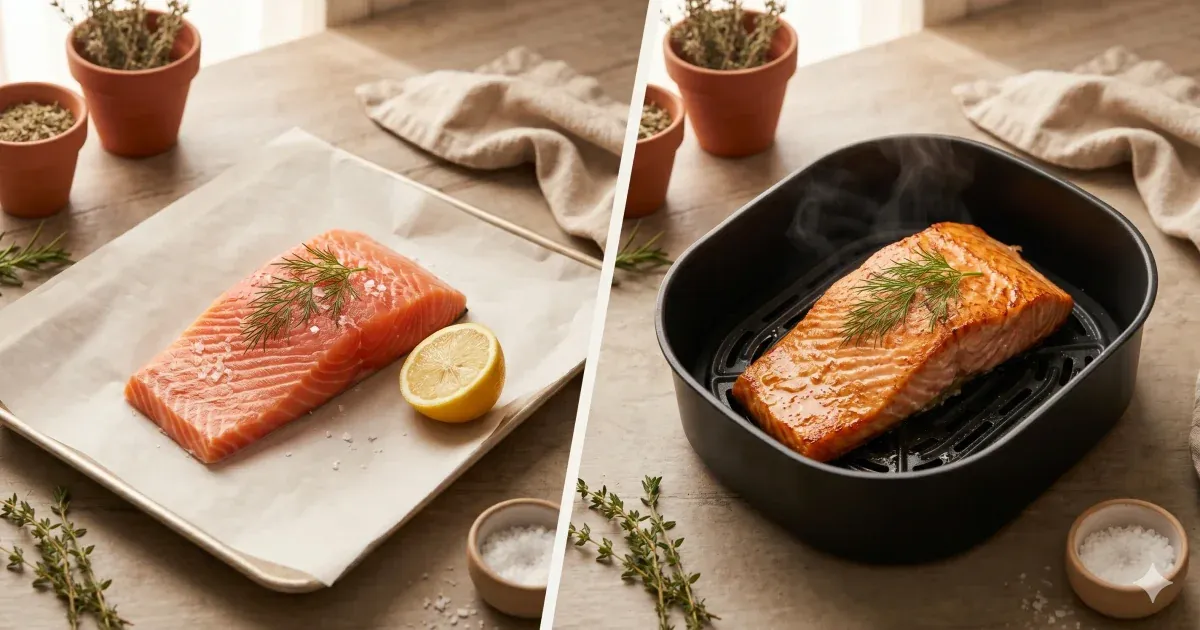
Salmon converts to the air fryer faster and more cleanly than most proteins. High fat content keeps the flesh moist under fast convection airflow, the skin crisps in roughly two minutes flat, and the USDA-safe internal target is 145°F: 20 degrees lower than poultry and reachable in under nine minutes for a standard 1-inch fillet.
The conversion starts from the standard 25-25 rule with one caveat: salmon is more forgiving on temperature than chicken, but less forgiving on time. A 30-second overshoot turns moist into dry. The chart below covers the most common starting points; pull on internal temperature, not the timer.
Note the temperature target. USDA FSIS lists 145°F for fish, distinct from the 165°F target for poultry. Both are non-negotiable for the immune-compromised; we publish 145°F as the safe baseline for healthy adults as well.
Recipe steps
1. Dry and salt
Pat skin and flesh dry with paper towels. Salt the skin lightly and let sit 10 minutes; the salt draws additional moisture and improves crisp formation.
2. Oil the flesh, not the skin
Brush 1 teaspoon of refined avocado or peanut oil on the flesh side. Leave the skin un-oiled; its natural fat renders during the cook.
3. Cook skin-down at 380°F
Place skin-down in a single layer. Cook at 380°F for 9 minutes (1-inch fillet) or 11 minutes (1.25-inch fillet). Do not flip.
4. Pull at 142°F and rest
Probe the thickest part at 7 minutes. Pull at 142°F; carryover brings the internal temperature to the USDA-safe 145°F during the 2-minute rest.
Quick Reference by Thickness
Use this table for individual fillets or steaks. The internal target is 145°F (63°C) per USDA FSIS for fish.
| Cut | Oven | Air Fryer |
|---|---|---|
| Skin-on, 1 inch thick | 400°F / 13 min | 380°F / 9 min |
| Skin-on, 1.25 inch thick | 400°F / 16 min | 380°F / 11 min |
| Skin-off, 1 inch thick | 400°F / 12 min | 380°F / 8 min |
| Frozen fillet, 1 inch (no thaw) | 400°F / 22 min | 380°F / 14 min |
| Salmon steak, 1.5 inch | 400°F / 18 min | 380°F / 13 min |
Always probe the thickest part. Salmon hits 145°F internal earlier than time alone suggests; pull on temperature, not the timer.
The 25-25 Rule Applied to Salmon
The standard oven-to-air-fryer conversion, the one our converter applies, takes 25°F off the temperature and 20 percent off the time, turning an oven recipe at 400°F for 13 minutes into 375°F for 10 minutes. The salmon chart departs from that on both counts. The same fillet cooks at 380°F for 9 minutes in the air fryer, 5°F warmer than the rule and about 30 percent under the oven time, with a single check at the 7-minute mark. Salmon tolerates the extra heat, and it reaches 145°F sooner than time alone suggests, so the chart times run short and the probe makes the final call.
Salmon's high natural fat content (16 to 20 percent in farmed Atlantic salmon, 8 to 10 percent in wild sockeye) means it tolerates the air fryer's concentrated airflow better than lean fish like cod or tilapia. The fat continuously self-bastes the flesh as the surface dries.
The bigger risk is overcook, not undercook. Every 5°F above the 145°F USDA target costs roughly 2 percent moisture content. A salmon fillet pulled at 150°F still tastes good. A fillet pulled at 160°F tastes notably drier and the texture turns from buttery to flaky-dry.
Skin-On Salmon for Crisp Skin
Crisp skin in an air fryer is the single biggest texture win over the oven. The high-velocity airflow pulls moisture off the skin in roughly two minutes; an oven needs the broiler to match it. Technique matters more than equipment.
Pat the skin completely dry. Salt it lightly 10 minutes before cooking; the salt draws additional moisture, which evaporates before the cook starts. Skip oil on the skin. The skin's own fat content (4 to 6 grams per 100g of salmon) renders and produces the crisp.
Place the fillet skin-down in the basket and cook the entire cycle without flipping. The flesh receives convection heat from above while the skin sits on the perforated basket floor with airflow underneath. After the cook, the skin lifts cleanly off the basket if it was dried properly before cooking.
Step-by-Step for Skin-On Salmon
- 1Pat skin and flesh thoroughly dry with paper towels. Visible moisture prevents crisp formation.
- 2Salt skin and flesh lightly. For skin-on cuts, let salt draw moisture for 10 minutes before cooking.
- 3Brush flesh with 1 teaspoon of refined oil and any seasoning; leave the skin un-oiled.
- 4Place skin-down in the air fryer basket. Single layer; do not stack fillets.
- 5Cook at 380°F for 9 minutes (1-inch fillets) without flipping.
- 6Probe the thickest part at the 7-minute mark. Pull at 142°F internal; carryover brings it to 145°F.
- 7Rest 2 minutes off heat. The flesh firms slightly and the residual heat distributes evenly.
Frozen Salmon Directly From the Freezer
Frozen salmon goes from the freezer to the basket without thawing. Total cook time is 14 minutes at 380°F for a 1-inch fillet, compared to 9 minutes from fresh. The first 4 to 5 minutes thaw the surface; the remaining 9 cook the flesh.
Quality from frozen is roughly 90 percent of fresh. The skin crisps slightly less because surface moisture takes longer to evaporate; flesh moisture is identical. Probe at the 12-minute mark and pull at 142°F as you would with fresh. Frozen fillets often have a colder core than expected when the surface looks done, so the probe check is non-optional.
Whole Side vs Individual Fillets
A 5.8-quart basket fits two 6-ounce fillets comfortably or three tight; a 3.5-quart fits one or two; an 8-quart or dual-basket fits four fillets in a single layer or one 1.5-pound salmon side cut to fit. A whole 2-pound salmon side does not fit any standard single-basket air fryer. Cut to 6-ounce portions before cooking.
Stacking fillets is the single most common salmon mistake. The bottom fillet doesn't crisp, the top overcooks, and temperature reads inconsistent across the basket. Cook in two batches if needed.
Glazes and Sauces That Survive the Airflow
Honey, maple, brown sugar, soy-based teriyaki, and most miso glazes contain enough sugar to burn at 380°F. Apply them only during the final 3 minutes of cooking, or finish after the cook with a brush.
Acid-based marinades (lemon, lime, vinegar) work well as pre-marinades because they break down protein for tenderness. Limit marinade time to 30 minutes; longer and the acid denatures the surface flesh, producing a mealy texture. Yogurt-based marinades (Indian-style, Greek-style) cling to the fillet without dripping; the lactic acid tenderizes without breaking down the surface.
Troubleshooting
Dry, flaky texture
Overcooked. Pull at 142°F for carryover to 145°F, and use a probe thermometer instead of relying on time alone.
Skin not crisp
Skin was wet at the start. Pat dry, salt 10 minutes ahead, and skip oil on the skin (use it only on the flesh side).
Skin sticks to the basket
Skin still wet, or basket not fully preheated. Pat skin dry; preheat the air fryer for 3 to 5 minutes, as Cosori and Ninja both direct, before adding fish.
Fishy smell during cooking
Salmon was past its prime, or has not been rinsed. Quick-rinse the fillet under cold water before patting dry.
Glaze burned
Glaze applied too early. Brush sugary glazes only during the final 3 minutes of cooking.
Center still translucent
Undercooked. Probe at thickest part; if below 142°F, add 1 to 2 minutes and re-check.
Brand-Specific Notes
Cosori Pro II and Pro LE 5.8-qt run accurately to dial; use the baseline 380°F and 9 minutes for a 1-inch fillet without adjustment.
Ninja Foodi and DualZone models run roughly 10°F hot. Drop to 370°F for the equivalent of 380°F on other brands. The DualZone's smaller baskets fit one fillet each comfortably; using both zones doubles capacity to 4 fillets in 9 minutes.
Instant Vortex Plus and Pro track close to dial. The Vortex Pro's rotisserie basket is too aggressive for salmon. The high-rotation airflow pulls flesh apart. Use the standard basket. Philips XXL Essential has a deeper basket; add 1 minute to the cook or raise temperature by 5°F.
Food Safety: USDA 145°F for Fish
USDA FSIS requires fish to reach an internal temperature of 145°F (63°C). This is 20°F lower than the 165°F target for poultry referenced in our chicken breast guide. The lower target reflects the lower thermal-death-point of fish-borne pathogens.
Use an instant-read thermometer probed into the thickest part of the fillet. Color is unreliable; salmon flesh changes from translucent red-orange to opaque pink before reaching 145°F internal. Trust the thermometer.
For immune-compromised diners (pregnant, elderly, immunosuppressed, very young), 145°F is the floor, not the target. Cross-contamination is the most common salmon failure: sanitize cutting boards and knives between raw handling and serving.
Frequently Asked Questions
What temperature do you cook salmon in an air fryer?
Cook salmon at 380°F (193°C) in an air fryer. The internal target is 145°F (63°C) per USDA FSIS, which is 20°F lower than the 165°F target for poultry. Probe the thickest part to verify.
How long do you cook salmon in an air fryer?
A standard 1-inch skin-on salmon fillet cooks in 9 minutes at 380°F without flipping. A 1.25-inch fillet needs 11 minutes. Frozen fillets need 14 minutes from frozen, no thaw required.
Can you cook frozen salmon in an air fryer?
Yes. Frozen salmon goes directly into the air fryer at 380°F for 14 minutes for a 1-inch fillet. The first 4 to 5 minutes thaw the surface; the remaining 9 cook the flesh. Always probe to 142°F before pulling.
Why is my air fryer salmon dry?
Overcooking is the cause 95 percent of the time. Every 5°F above 145°F costs roughly 2 percent moisture content. Pull at 142°F for carryover to 145°F, and rest 2 minutes before serving. Use a probe, not the timer.
How do I get crispy skin on air fryer salmon?
Pat the skin completely dry. Salt the skin 10 minutes before cooking to draw out additional moisture. Place the fillet skin-down in the basket. Skip oil on the skin; the skin's own fat renders during the cook. Do not flip.
Do I need to flip salmon in an air fryer?
No. Cook salmon skin-down through the entire cycle. Flipping disrupts the crisp formation on the skin and breaks the fillet apart at the flake lines. The convection airflow cooks the top side without flipping.
Is salmon safe at 145°F?
Yes, 145°F is the USDA FSIS minimum internal temperature for fish, including salmon. This is the safe target for healthy adults and the non-negotiable floor for immune-compromised, pregnant, elderly, or very young diners.
Sources & references
Internal-temperature claims on this page link to primary food-safety sources. Conversion baselines come from in-kitchen testing on the units listed.
USDA FSIS Safe Minimum Internal Temperature Chart
The 145°F target for fish, including salmon, distinct from the 165°F target for poultry.
FoodSafety.gov Cook to a Safe Minimum Internal Temperature
Cross-government reference confirming 145°F for fish and seafood.
Health Canada Safe Internal Cooking Temperatures
Canadian guidance: 70°C / 158°F for fish, slightly higher than USDA; both cited for cross-border readers.
Cosori Pro II 5.8-Qt Manual
The Seafood preset (350°F for 8 minutes) and the Shrimp preset (370°F for 6 minutes), referenced in the brand-specific section.
Ninja AF101 Owner's Guide
Recommends letting the unit preheat for 3 minutes before adding ingredients. Cited where this page says Ninja tells you to preheat.
Bottom Line
Air fryer salmon is faster, crispier, and more forgiving than oven salmon if you follow three rules: pat dry, cook skin-down at 380°F without flipping, and pull at 142°F internal for carryover to 145°F.
The USDA target for fish is 145°F, which is 20°F lower than poultry. A probe thermometer is the difference between perfect and dry; the timer is a starting point, not the answer.