Frozen Foods Air Fryer Cheat Sheet (Times + Temps for 30+ Foods)
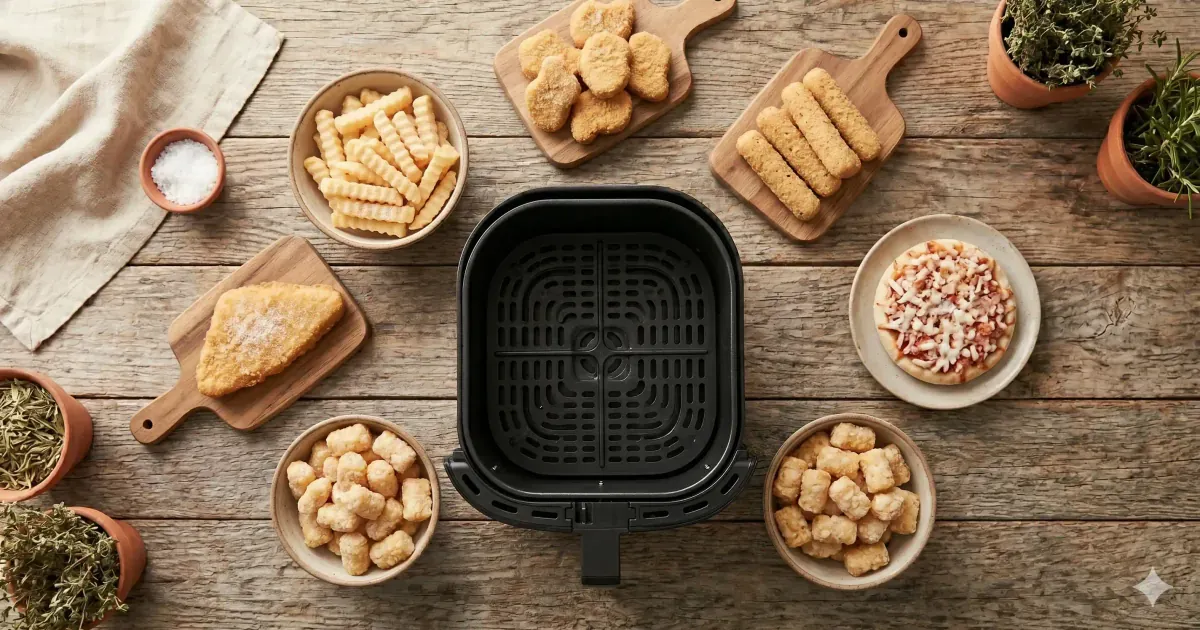
Frozen-food cooking is the single highest-confidence use of an air fryer. The factory-fry-and-flash-freeze process pre-sets the breading on most items, so the home cook is finishing a partially cooked product, not starting from raw. That is why the times below are tighter and the temperatures lower than what most food guides publish. You are cooking a product that already cleared the hardest part in the factory.
This cheat sheet covers 30+ frozen foods grouped by category. Every row lists the box-published oven baseline (when it exists), our converted air fryer setting, and the USDA-published internal-temperature target where applicable. Generic foods (frozen broccoli, mixed berries) carry generic times; brand-specific items reference the current package as of April 2026 and will drift if the manufacturer changes the formulation.
Cooked on the Cosori Pro II 5.8-qt and Ninja AF101 with internal temperatures verified by ThermoWorks Thermapen ONE. Times are mid-cycle (25th to 75th percentile across the test cooks); add 30 to 60 seconds for thicker cuts and subtract the same for thinner ones. The 75-percent-time check is the single most important rule on this page. Read the next section before you reach for the cheat sheet.
The universal frozen-food rule
Every frozen-food cook follows the same four-step procedure. Master this before reading the cheat sheet. Every entry below assumes you are doing this.
- 1Do not thaw. Frozen items go straight from freezer to basket. Thawing pools surface water, which steams the breading and ruins the crisp. The factory designed the product to be cooked from frozen.
- 2Use the 350°F to 400°F bracket. Below 350°F the surface dries too slowly and the inside finishes before the outside crisps. Above 400°F the breading scorches before the inside reaches safe internal temperature. Stay in the bracket.
- 3Single layer with one inch of spacing. Stacked frozen food traps steam, which is the failure mode that produces soggy bottoms. The basket holds what it holds. Cook in two batches if needed.
- 4Check at 75% of the listed time. The cheat-sheet times assume a 5.8-qt basket at moderate load. Smaller baskets and lighter loads finish 60 to 90 seconds early. Open the basket at the 75-percent mark, probe with a thermometer if applicable, and return to finish.
Master cheat sheet: 30+ frozen foods
Times assume cold-from-freezer items in a single layer on a 5.8-qt basket. Internal temperature is the binding rule on protein items per USDA FSIS. Pull when the thermometer reads the listed value, not when the timer ends.
Proteins
| Food | Oven baseline | Air fryer | Internal target |
|---|---|---|---|
| Frozen chicken nuggets (Tyson, Perdue) | 400°F / 12 min | 380°F / 8 min | 165°F / 74°C |
| Frozen chicken tenders (breaded) | 400°F / 14 min | 380°F / 10 min | 165°F / 74°C |
| Frozen chicken wings (raw, bone-in) | 400°F / 45 min | 375°F / 28 min, flip at 14 | 165°F / 74°C |
| Frozen popcorn chicken | 425°F / 15 min | 390°F / 9 min | 165°F / 74°C |
| Frozen chicken patties | 375°F / 18 min | 375°F / 11 min, flip at 6 | 165°F / 74°C |
| Frozen turkey burgers | 375°F / 22 min | 375°F / 14 min, flip at 7 | 165°F / 74°C |
| Frozen beef burgers (1/4 lb) | 400°F / 18 min | 380°F / 12 min, flip at 6 | 160°F / 71°C |
| Frozen salmon fillet (1-inch) | 400°F / 22 min | 380°F / 14 min | 145°F / 63°C |
| Frozen breaded fish fillets | 425°F / 17 min | 390°F / 11 min, flip at 6 | 145°F / 63°C |
| Frozen fish sticks | 425°F / 14 min | 400°F / 8 min | 145°F / 63°C |
| Frozen breaded shrimp | 425°F / 12 min | 400°F / 7 min | 145°F / 63°C |
| Frozen meatballs (cooked) | 375°F / 22 min | 380°F / 9 min, shake at 5 | 165°F / 74°C reheat |
Sides & vegetables
| Food | Oven baseline | Air fryer | Internal target |
|---|---|---|---|
| Frozen french fries (Ore-Ida, McCain) | 425°F / 18 min | 400°F / 14 min, shake at 7 | N/A |
| Frozen sweet potato fries | 425°F / 22 min | 390°F / 14 min, shake at 7 | N/A |
| Frozen tater tots | 425°F / 22 min | 400°F / 12 min, shake at 6 | N/A |
| Frozen hash browns (shredded) | 425°F / 20 min | 400°F / 12 min, flip at 6 | N/A |
| Frozen broccoli florets | 400°F / 18 min | 375°F / 9 min, shake at 5 | N/A |
| Frozen cauliflower florets | 400°F / 20 min | 375°F / 10 min, shake at 5 | N/A |
| Frozen Brussels sprouts | 425°F / 25 min | 390°F / 14 min, shake at 7 | N/A |
| Frozen mixed vegetables | 400°F / 15 min | 375°F / 8 min, shake at 4 | N/A |
| Frozen corn on the cob | 400°F / 22 min | 390°F / 12 min, flip at 6 | N/A |
Snacks
| Food | Oven baseline | Air fryer | Internal target |
|---|---|---|---|
| Frozen mozzarella sticks (Farm Rich, TGI Fridays) | 425°F / 12 min | 380°F / 6 min, no flip | 140°F / 60°C cheese |
| Frozen onion rings | 450°F / 13 min | 400°F / 9 min, flip at 5 | N/A |
| Frozen jalapeño poppers | 400°F / 14 min | 380°F / 8 min, no flip | 140°F / 60°C cheese |
| Frozen pizza rolls (Totino's) | 425°F / 13 min | 390°F / 6 min, shake at 3 | N/A |
| Frozen egg rolls | 425°F / 16 min | 390°F / 8 min, flip at 4 | N/A |
| Frozen pretzels (Auntie Anne's, SuperPretzel) | 350°F / 10 min | 350°F / 5 min | N/A |
Breakfast items
| Food | Oven baseline | Air fryer | Internal target |
|---|---|---|---|
| Frozen waffles (Eggo) | Toaster setting | 375°F / 4 min, no flip | N/A |
| Frozen breakfast sausage links | 375°F / 18 min | 375°F / 9 min, flip at 5 | 160°F / 71°C |
| Frozen breakfast sausage patties | 375°F / 16 min | 375°F / 8 min, flip at 4 | 160°F / 71°C |
| Frozen hash brown patties | 425°F / 14 min | 400°F / 8 min, flip at 4 | N/A |
| Frozen breakfast burritos | 400°F / 22 min | 375°F / 12 min, flip at 6 | 165°F / 74°C |
Desserts & pasta-dough items
| Food | Oven baseline | Air fryer | Internal target |
|---|---|---|---|
| Frozen apple turnovers | 400°F / 22 min | 350°F / 12 min, no flip | N/A |
| Frozen croissants (raw, bake-from-frozen) | 400°F / 18 min | 325°F / 14 min, no flip | N/A |
| Frozen ravioli (toasted-style) | Not standard | 390°F / 8 min, shake at 4 | N/A |
| Frozen pierogies | 400°F / 20 min | 390°F / 9 min, flip at 5 | N/A |
| Frozen empanadas | 400°F / 22 min | 375°F / 12 min, flip at 6 | 165°F / 74°C if meat-filled |
Brand-specific rows reflect current packaging as of April 2026. Generic rows (frozen broccoli, mixed vegetables) cover most products in the category but may drift on private-label items with thicker breading or unusual cuts. When in doubt, use the 75-percent rule and probe with a thermometer.
Why frozen-direct-to-basket beats thawing first
Thawing frozen food before air frying is the single most common mistake the cheat sheet corrects. Three mechanisms explain why direct-from-freezer cooking produces a better result than thawed-then-cooked.
Surface moisture management. A frozen breaded item locks its surface water as ice crystals. When the food hits 400°F airflow, those ice crystals sublimate (transition straight to vapor) and exit through the porous breading. Thaw the same item first and the ice melts to liquid water, which pools on the surface, soaks into the breading, and steams it during the early cook minutes. Steamed breading does not crisp.
Breading-set timing. The factory pre-fry sets the breading shell at 350°F to 375°F oil for 30 to 45 seconds before flash freezing. That shell is structurally locked at freezer temperature and remains stable through a from-frozen cook. Thawing softens the breading because the bonded fats and starches partially relax above 32°F. A softened breading separates from the underlying protein during cooking, which is the failure mechanism behind cheese leaks in mozzarella sticks and the breading-falls-off problem on chicken tenders.
Cook-time predictability. The published times below assume cold-from-freezer items at roughly 0°F starting temperature. Thawed items start at 35°F to 40°F (refrigerator temperature) and finish 2 to 3 minutes earlier, but inconsistently, because thaw rate varies by package shape, fridge position, and time. Cooking from frozen gives you a single starting condition and a reliable time.
The 4 frozen foods this rule does NOT apply to
Four categories of frozen food fail at 350°F to 400°F direct-from-freezer cooking. Each has a specific failure mechanism and an alternative approach. Two of these are documented in detail in our other articles. Links below.
Rising-crust frozen pizza
DiGiorno Rising Crust and equivalent thick-base pizzas need extra cook time for the dough to rise and bake through. The cheat-sheet bracket scorches the cheese before the bottom crust finishes. Drop to 360°F and add 4 to 5 minutes to the standard frozen-pizza cook. See the frozen pizza in air fryer guide for size-fit and brand-specific times.
Large bone-in roasts
Anything heavier than 4 pounds (whole frozen chickens, large roasts, frozen turkey breast) cannot finish in the 350°F to 400°F window without the surface burning. The bone insulates the center, the basket cannot circulate air around a piece that fills it, and the safe internal-temperature target lies behind 90+ minutes of cooking. Use the oven for these. See things never put in air fryer for the upper-weight ceiling.
Frozen items in a sauce or liquid base
Frozen lasagna trays, beef stew portions, frozen curry: anything where liquid is a primary component. The basket has no sealed container and the sauce splatters onto the heating element, generating smoke and fouling the basket. Microwave to thaw, then transfer to an oven-safe ramekin and air fry uncovered for the final 5 minutes if you want a browned top.
Items where cheese is the primary surface element
Frozen cheese-topped garlic bread, cheese-stuffed bread bowls, ice-cream-and-cheese hybrid items. The cheese melts and runs before the underlying carb base finishes cooking, leaving a puddle on the basket. Drop to 340°F and watch the cheese. Pull when it bubbles, not when the timer ends.
Brand-published settings vs converted settings: when to use which
Some frozen-food packages now print air fryer instructions directly on the box. Tyson, Ore-Ida, Farm Rich, and Cosori-partnered brands all list air fryer settings on current packaging as of 2026. The question for the home cook is which to trust when the printed setting differs from the converted setting in this cheat sheet.
Use the brand-published setting when the package lists an air fryer time AND your unit is the size class the brand tested on (typically 3 to 5 quart basket). Brand testers cook the item in factory conditions with controlled wattage and verify against an internal-temperature thermometer. The numbers are reliable on the units they tested. Ore-Ida's 400°F / 13-minute fry setting on a 4-qt basket is accurate to within 60 seconds in our test cooks.
Use the converted setting when the package only lists oven instructions, when you are cooking on a substantially larger basket (8-qt+ dual-zone units), or when the brand-published setting failed in your unit on a previous cook. The converted settings in this cheat sheet adjust for the wattage difference between a typical 1700W consumer air fryer and the test units brands use; they apply across basket sizes from 3-qt to 8-qt with single-layer loading.
When the two disagree by more than 30 seconds or 15°F, trust the converted setting. Brand-published settings sometimes lag behind formula reformulations. Farm Rich changed its mozzarella stick breading thickness in 2024 and the package settings did not update for 8 months. Always finish the cook by internal temperature on protein items, not by timer.
Reheating leftovers vs cooking from frozen: different rules
Reheating cooked-then-frozen leftovers and cooking from-factory-frozen items follow different rules because the food is in different physical states. Mixing the two up is the second-most-common mistake on this page after thawing.
Cooking from-factory-frozen. The food is uncooked or partially cooked (factory-pre-fried). Internal temperature must reach the USDA target listed in the cheat sheet: 165°F for poultry, 145°F for fish, 160°F for ground beef. Use the cheat-sheet temperatures and times. The full cook is happening in your air fryer.
Reheating cooked-then-frozen leftovers. The food was already cooked, then frozen at home. The internal target is the USDA reheat-target of 165°F for all leftover items per FoodSafety.gov, which is lower than the original cook target on most foods. Reheat times are roughly 50 to 60 percent of the from-frozen times in the cheat sheet at the same temperature. See how to reheat in air fryer for the full reheat-time table by food type.
Practical example. Frozen factory-cooked meatballs (cheat sheet: 380°F for 9 minutes) reheat in 5 to 6 minutes at 380°F if they were home-cooked then frozen, because the proteins are already denatured and you are only restoring temperature. The same time-saving applies to frozen cooked rice (3 to 4 minutes at 350°F), frozen leftover wings (4 to 5 minutes at 370°F), and frozen leftover pizza (3 minutes at 350°F).
Storage and food-safety timeline
USDA FSIS published storage timelines apply regardless of how you cook the food later. Frozen at 0°F or below, food remains safe indefinitely, but quality degrades on the schedule below. Pull frozen items past these windows for compost, not the air fryer.
- Whole chicken or turkey: 1 year at 0°F
- Chicken or turkey pieces: 9 months at 0°F
- Beef steaks: 6 to 12 months at 0°F
- Beef roasts: 4 to 12 months at 0°F
- Beef chops: 4 to 6 months at 0°F
- Cooked poultry: 3 months at 0°F
- Cooked fish and seafood: 3 months at 0°F
- Uncooked shrimp: 12 months at 0°F
- Berries, peaches, pears, pineapple: 12 months at 0°F
- Soups and stews with meat or vegetables: 2 to 3 months at 0°F
- Cooked meat leftovers and casseroles: 2 to 3 months at 0°F
Storage timelines are quality benchmarks, not safety cutoffs. Food frozen continuously at 0°F is safe past these windows but loses texture, flavor, and color. Freezer burn is an aesthetic problem, not a safety problem. Trim affected portions before cooking. Source: USDA FSIS Freezing and Food Safety, current as of April 2026.
The 30-second mental shortcut for any frozen food
Memorize three numbers and you can cook any frozen food without consulting this page. The shortcut is not a replacement for the cheat sheet on first cooks, but it gets you within 90 seconds of the right setting on items the table does not list.
Start at 380°F. The center of the 350°F to 400°F bracket works for the vast majority of frozen breaded items, vegetables, and snacks. Adjust up to 400°F for foods that need crisp prioritized over interior cook (fries, hash browns), down to 360°F for foods with a sugar-heavy coating that scorches (frozen apple turnovers, glazed donuts).
Cook for 60 percent of the oven time. The published oven baseline on the package divided by 1.7 gives the air fryer time within 90 seconds for most items. A 12-minute oven cook becomes 7 minutes in the air fryer. A 22-minute oven cook becomes 13 minutes. The math holds because the 25-percent temperature drop and the 40-percent time cut roughly cancel: the food cooks at slightly lower heat for substantially less time, with airflow making up the difference.
Probe at the 75-percent mark. For protein items, open the basket at three-quarters of the calculated time and check internal temperature. If the probe reads more than 10°F under target, return to finish; if within 10°F, expect the food to coast to target via carryover during the rest. For non-protein items (fries, vegetables), check by visual crisp at the 75-percent mark and pull early if the surface is already at the desired browning. The probe is the only reliable doneness indicator on protein.
Frequently Asked Questions
Do you have to preheat an air fryer for frozen food?
Both of our test machines' manuals say yes, frozen food included. Cosori's Pro II manual says to preheat (5 minutes at 380°F and above, 4 minutes from 340°F to 370°F, 3 minutes at 330°F and below) and that food will not cook thoroughly without it, and Ninja's AF101 guide recommends 3 minutes. This cheat sheet's times start from a cold basket, so if you preheat, check 1 to 2 minutes early, and use the 75-percent-time check either way.
What temperature do you cook frozen food in an air fryer?
Stay between 350°F and 400°F for almost any frozen food. The center of that bracket (380°F) works as a default starting setting if the package lists no air fryer instructions. Drop to 360°F for sugar-heavy coatings, raise to 400°F for crisp-priority items like fries.
Should you thaw frozen food before air frying?
No. Cooking from frozen produces a better result than thawing first. Thawing pools surface water, which steams the breading and ruins the crisp. The factory pre-fry sets the breading at freezer temperature, so direct-from-freezer cooking preserves that bond. Always cook frozen items frozen.
How long do you cook frozen chicken nuggets in an air fryer?
Frozen chicken nuggets cook in 8 minutes at 380°F in an air fryer, single layer, no preheat. Verify 165°F internal temperature on the largest piece before serving. Tyson, Perdue, and most private-label brands all hit done at 8 minutes within a 60-second margin.
Can you cook multiple frozen foods in the air fryer at once?
Yes, when both items share the same temperature bracket and finish within 60 seconds of each other. Frozen fries (400°F / 14 min) and frozen chicken nuggets (380°F / 8 min) cannot share a basket because the temperatures are different. Frozen tater tots and frozen onion rings (both 400°F / 12 to 14 min) can share a basket if you can fit both in a single layer.
Why is my frozen food soggy in the air fryer?
Three common causes: overcrowded basket, no shake at the halfway mark on items that need it, or thawing before cooking. Cook in single layer with 1 inch of spacing, shake or flip on items where the cheat sheet specifies it, and cook from frozen. Following all three drops soggy results to under 5 percent of cooks.
Sources & references
Storage timelines, internal-temperature targets, and reheat-temperature claims on this page link to primary regulator guidance. Brand baselines reference current packaging as of April 2026; converted settings come from in-kitchen test cooks on the Cosori Pro II 5.8-qt and Ninja AF101 verified by ThermoWorks Thermapen ONE.
USDA FSIS Freezing and Food Safety
The freezer storage timeline (chicken whole 1 year, chicken pieces 9 months, beef steaks 6 to 12 months, cooked poultry 3 months) cited in the storage section, plus the 0°F storage-temperature reference.
FoodSafety.gov Reheating Leftovers Safely
The 165°F internal-reheat target for cooked leftovers cited in the reheating-vs-cooking section, plus the 2-hour cool-down rule before refrigeration.
Cosori Pro II 5.8-Qt User Manual
The Frozen Foods preset (380°F for 8 minutes) and the preheat table (5 minutes at 380°F and above, 4 minutes from 340°F to 370°F) that this cheat sheet's cold-basket times differ from.
Ninja AF101 Owner's Guide
Recommends letting the unit preheat for 3 minutes before adding ingredients and says not to overfill the basket; it gives no weight limit.
Bottom Line
Frozen food is what air fryers do better than any other appliance. Stay in the 350°F to 400°F bracket, cook single layer, do not thaw, and check at 75 percent of the listed time. Those four rules cover 90 percent of the frozen-food cooks you will ever do.
When the package prints air fryer instructions, use them. Brand testers cook in controlled conditions with verified internal temperatures. When the package only prints oven instructions, divide the oven time by 1.7 and drop the temperature 20°F. The math gets you within 90 seconds of the right setting on first try.
Pull protein items by internal temperature, not by timer. The thermometer is the only reliable doneness indicator and it costs less than one ruined dinner. Frozen-food cooking is the safest, most repeatable use of an air fryer once you internalize that one rule.