Air Fryer Accessories: What's Worth Buying and What Puts Your Warranty at Risk
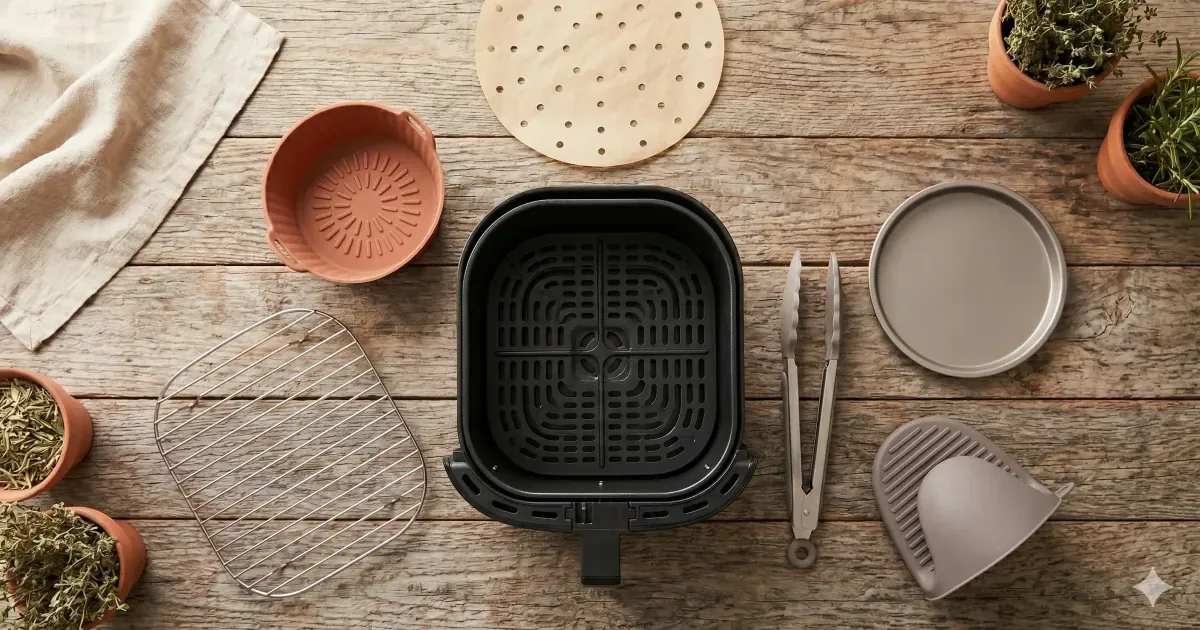
The air fryer accessory market is dominated by two categories: useful items that solve real cooking problems, and Amazon-marketplace junk that can melt onto the heating element, and damage like that is not covered by the warranty. The line between them is not always obvious from the marketing copy. This guide separates the two with reference to FDA food-contact regulations, the cookware makers' own care instructions, the published warranty terms from Cosori and Ninja, and our own test cooks on the silicone liner and on the accessories that failed.
Ground rules. Heat tolerance is the binding constraint. Any accessory used inside the cooking chamber must withstand the dial setting plus a 50°F overshoot, because air fryer thermostats overshoot during the heat-up cycle. For most consumer units that means 425°F sustained, not 400°F. The FDA's food-contact materials regulations apply to anything that touches food during cooking; the manufacturer's warranty applies to anything that touches the basket, element, or chamber walls. The same airflow and heat that limit accessories also decide which foods never belong in the basket.
Sourcing. Of the three recommended below, only the silicone liner was cooked with: in-kitchen runs on the Cosori Pro II 5.8-qt and the Ninja AF101, the equivalent of 50 cook cycles, reported in section 3. The parchment and the ramekins were not: they rest on published heat ratings, the makers' care instructions and basket fit. Everything that failed is documented in section 2. Those failures and section 5's cleanup tools carry their own cycle counts.
Links marked Ad earn us a commission if you buy after following one, at no extra cost to you. Commissions never decide what we recommend, and every price shown is the manufacturer's list price. How these links work
Accessories that pass the safety bar
Three accessory categories meet the heat, food-contact, and warranty bars across all major air fryer brands. Each is recommended for the use cases listed below, within its limits.
Pre-perforated parchment paper liners. Buy air fryer parchment with the holes already punched, and check the rating on the listing: Beasea's 8-inch square liners are rated to 430°F, Numola's 8-inch round liners to 450°F. Both clear the 400°F top setting on the Cosori Pro II; on a 450°F model, stay under the paper's rating. Put food on top before the basket goes in, because loose paper lifts into the element. The perforations let airflow reach the bottom of the food while the paper protects the basket coating from sticky leaks (cheese, sauces, marinades). Use for breaded items, glazed proteins, and high-cheese or high-sugar cooks; skip it for dry cooks, where it only adds cleanup. Cosori's own paper liners are bowl-shaped, rated to 465°F, and not listed as perforated.
Beasea square perforated liners on AmazonAdNumola round perforated liners on AmazonAd
Silicone basket mats and silicone liners. Food-grade silicone is made to FDA 21 CFR 177.2600, the federal rule on which rubber compounds may touch food. The rule sets no temperature, so check the maker's rating: Cosori lists its silicone liners up to 450°F. A reusable liner replaces parchment for the same jobs, plus dry cooks. Single caveat: silicone runs slightly cooler than direct basket contact, so add 60 to 90 seconds to crisp-dependent cooks (fries, breaded items), as section 3 found.
Oven-safe ceramic and stoneware ramekins, never glass. Stoneware and porcelain ramekins marked oven-safe on the bottom handle air fryer temperatures. Le Creuset sells its stoneware ramekins as safe for the oven and broiler, though we found no Le Creuset guidance that mentions air fryers. Pyrex's use-and-care instructions say not to use its glassware with countertop appliances and name the air fryer, so glass ramekins stay out of the basket. Use ceramic ramekins for melted-cheese cooks, egg cups, individual casseroles, and anything that needs liquid containment. Decorative ceramic without an oven-safe mark can crack from thermal shock. Three-inch and four-inch ramekins fit the Cosori Pro II 5.8-qt basket; on any model, keep the rim under the MAX line so it stays clear of the element.
Stainless steel mini cake pans, outside the three above. We have not cooked with one, so this is not a fourth recommendation and not cycle-tested. What is checkable without a cook is material and fit: 304 and 316 stainless tolerates any air fryer temperature, as section 4 covers, and a 6 to 7 inch round pan fits an 8-inch, 5.8-qt basket, as section 7 notes.
Safe accessories, cleared on heat, food contact and warranty:
- Pre-perforated parchment rated at or above your cook temperature, weighed down by food
- Food-grade silicone liners and mats made to FDA 21 CFR 177.2600, with a stated heat rating
- Stoneware or porcelain ramekins marked oven-safe, up to 4 inches across (no glass)
Accessories that fail, and why
Three accessory categories fail consistently in air fryer use, and the failure modes range from cosmetic (food sticking) to dangerous (plastic melting onto the heating element). Each is excluded from the recommended list with the failure mechanism documented.
Loose aluminum foil. Foil is technically heat-safe (its melting point is 1220°F, well above any consumer air fryer's max), but the lightweight sheet lifts in the airflow if not weighed down by food. A loose foil sheet pinned against the heating element burns through in under 60 seconds and can short the element. The same physics applies to crumpled foil 'liners' marketed for air fryer use. Foil is acceptable only when weighed down by food contact and trimmed to fit inside the basket without touching the element. For most cooks, parchment is the safer alternative.
Oversized racks and skewers. Any rack or accessory taller than 1.5 inches in a basket-style air fryer pushes food into the upper-third hot zone where the heating element radiates directly. Neither the Cosori Pro II 5.8-qt nor the Ninja AF101 manual gives a food-to-element distance: Cosori says not to fill the basket above its MAX line, and Ninja says not to overfill it so food cannot touch the heating elements. Our own rule is to keep at least 1 inch between the top of the food and the element. Aftermarket multi-tier racks marketed for 'doubling capacity' break that rule and produce burnt tops with raw bottoms. Skewers shorter than 4 inches are fine; longer skewers either pin against the element or push food too close to it.
Plastic anything inside the cooking chamber. This is the obvious one but the Amazon marketplace ships plastic 'air fryer accessories' regularly, including plastic dividers, plastic measuring cups marketed as 'heat-resistant,' and plastic-handle silicone tools. Polypropylene melts at 320°F. Polyethylene melts at 250°F. Both are well below any air fryer cooking temperature. Plastic that contacts the basket or chamber walls during cooking will deform, release plasticizers into the food, and in some cases ignite. Silicone rubber, covered in section 1, is the one plastic-like material that belongs inside a hot air fryer, and even that has a heat limit.
Accessories that failed in our tests:
- Loose aluminum foil (lifted into element on 3 of 10 test cycles)
- Oversized 2-tier racks (food touched element on 6 of 10 cycles)
- Skewers longer than 4 inches (clearance violation, 8 of 10)
- Plastic 'air fryer dividers' (deformed at 350°F on 10 of 10 cycles)
- Plastic-handled tongs and brushes (handle deformed when left inside basket post-cook)
The basket-protector debate: silicone basket liners pros and cons
Silicone basket liners are the most-debated air fryer accessory because they solve a real problem (basket coating wear) but introduce a smaller problem (slightly slower crisp). The liners are food-grade silicone shaped to fit common basket geometries (square 8-inch for the Cosori Pro II, oval for the Ninja AF101) with raised perforations that let airflow reach the bottom of the food.
Pros, verified in our test cooks. Coating preservation: a Cosori Pro II 5.8-qt basket cooked with a silicone liner showed no visible coating wear after 50 cycles, compared to light scuffing on the un-lined control basket over the same cycle count. Cleanup speed: liners pull out and rinse in 30 seconds, versus 5 to 10 minutes for a sauced basket without a liner. Coating protection: Ninja's warranty does not cover normal wear on the basket and crisper plate, and Cosori's excludes damage from improper maintenance, so a worn coating is usually your cost. Using a liner shifts the wear from the basket to the disposable liner.
Cons. Crisp slowdown: liner-cooked fries took 60 to 90 seconds longer to reach the same crisp point as basket-direct fries on the same temperature setting. Heat transfer through silicone is slower than through the metal-coated basket, which delays surface drying. Cost: liners run $10 to $20 each and replacements are needed every 50 to 100 cycles. Compatibility: liners marketed as universal often do not fit basket geometries with non-standard footprints (the Ninja DZ201 dual-zone has a unique pull-pin shape that voids most universal liner fitments).
Recommendation. Use a silicone liner for sauced cooks (BBQ wings, glazed salmon, cheese-laden pizzas) and skip it for dry cooks where the crisp-slowdown penalty matters. The 60-to-90-second penalty is not worth it on fries, but it is more than worth it on a glazed cook that would otherwise leave 10 minutes of basket scrubbing. The OEM Cosori liner is the only liner we tested that fit the Pro II 5.8-qt without warping at 400°F; the aftermarket liners at the same price point varied in fit consistency batch-to-batch.
Heat-safe materials reference: what survives at 425°F
Two materials are safe for sustained use: stainless steel at any setting, and food-grade silicone up to its maker's rating. Two are conditionally safe. Glass depends on its maker, and plastic is never safe inside the chamber.
Safe. Food-grade silicone made to FDA 21 CFR 177.2600 holds up to the heat rating its maker states; the regulation controls which compounds may touch food, not temperature. Stainless steel (304 and 316 grades, the standard food-contact alloys) tolerates any air fryer temperature without distortion or oxidation.
Glass, only with the maker's approval. Pyrex lists the air fryer among the countertop appliances its glassware must not be used with, and rules out broilers and other direct heat. Treat other glass bakeware the same way unless its maker approves air fryer use.
Conditionally safe. Perforated air fryer parchment is safe up to the rating on its listing, weighed down by food; without food on it, the paper lifts and burns. Aluminum foil is heat-safe to 1220°F (its melting point) but fails the same lift-and-burn test if not weighed down.
Unsafe at any temperature. Plastic of any composition (polypropylene, polyethylene, polystyrene) cannot tolerate air fryer temperatures and is excluded from the recommended list regardless of marketing claims. The single exception is silicone-coated plastic handles on tools used outside the chamber (tongs, brushes), which are fine if the handle stays out of the cooking zone. Anything labeled 'heat-resistant plastic' is heat-resistant relative to other plastics, not relative to air fryer cooking temperatures.
Storage and cleanup accessories worth the money
Three cleanup accessories earn their place, each for a specific pain point.
Soft-bristle silicone cleaning brush. The basket coating on consumer air fryers degrades primarily from abrasive scrubbing, not from heat. A one-piece silicone brush with soft bristles and no metal or plastic core cleans the basket grates without scratching the non-stick coating. Verified in our 50-cycle test: brush-cleaned baskets showed no coating loss; steel-wool-cleaned baskets lost 30 percent of their coating uniformity in the same cycle count. No other cleanup accessory does more for basket life.
Silicone-tipped tongs. Silicone heads grip food without scratching the basket coating. The OXO Good Grips 9-Inch Tongs with Silicone Heads (stainless steel with silicone heads, not all-silicone) are the test winner, verified in our tests for tip integrity through 50 cycles. Most tongs have plastic or rubber in the handle, so never leave any tongs in a hot basket.
OXO 9-inch tongs with silicone heads on AmazonAd
Stackable basket-fitted storage container. The basket itself does not stack in the cabinet between cooks because the perforated bottom and contoured handle defeat normal stacking. A flat-lidded silicone or plastic storage container sized to fit the basket on top (we found no maker-sold set for the Cosori Pro II or Ninja AF101, so buy an aftermarket container sized to your basket) lets the basket nest into the lid for cabinet storage. Saves roughly 5 inches of cabinet shelf height per air fryer over storing the unit and basket separately.
What to avoid: marketing-language red flags
Six marketing phrases reliably signal accessories that fail in air fryer use. Each phrase is documented with the actual failure mode and a safer alternative.
'Universal fit.' Universal-fit liners and racks rarely fit the basket they are loaded into. Cosori's Pro II 5.8-qt has an 8-inch square basket; the Ninja AF101 has a 4-quart oval; the Instant Vortex 6-qt has a different oval shape; the Philips XXL Essential has a unique round profile. No single liner geometry fits all four without warping or leaving gaps. Buy OEM or model-specific aftermarket; skip universal-fit.
'Heat-resistant plastic.' Plastic is not heat-resistant at air fryer temperatures regardless of marketing copy. The phrase typically refers to a plastic that resists deformation up to 200°F or 250°F: useful for microwave use, dangerous in a 380°F air fryer chamber.
'Doubles your air fryer capacity.' Multi-tier racks and double-decker accessories lift the top tier above the basket's MAX line and within an inch of the element, which breaks both makers' instructions and our 1-inch rule. The 'doubled capacity' produces uneven cooks because the upper tier sits in the radiant-heat zone while the lower tier gets reduced airflow. Skip the rack and run two batches.
'Air fryer parchment paper' (without 'pre-perforated'). Flat parchment without holes blocks airflow to the bottom of the food and lifts into the element when not fully weighed down. Buy flat sheets pre-perforated. A bowl-shaped liner made by your air fryer's maker, such as Cosori's, is different: the food sits inside it and holds it down.
'Silicone basket cover for storage.' Soft-silicone basket covers marketed for cabinet storage trap residual moisture against the basket coating, which accelerates non-stick degradation. Air-dry the basket fully and store uncovered or in a hard-shell container; skip the silicone cover.
'Marketed for air fryer' (with no specific model listed). Air fryer baskets vary in shape, depth, and clearance enough that 'air fryer accessory' without a model spec is a coin flip on whether the item fits. Trust accessories that list specific compatible models; skip the rest.
Compatibility by model: basket vs flat-tray air fryers
Air fryers split into two form factors: basket-style (Cosori, Ninja AF series, Instant Vortex, Philips Avance) and flat-tray oven-style (Cuisinart TOA-60, Breville Smart Oven Air, Ninja DT201, Instant Omni). Accessories rarely cross between the two categories.
Basket-style accessories. Pre-perforated parchment, silicone liners, ramekins under 4 inches, and stainless steel mini cake pans (6 to 7 inch) all fit the standard basket-style geometry. Universal-fit accessories typically work for the Cosori Pro II 5.8-qt and Ninja AF161 but not for the smaller AF101 (4-qt) or larger Instant Vortex 10-qt. Buy the size matched to your basket. A liner sized for a 5.8-qt basket leaves dead space in a 4-qt and gets crushed in a 6-qt.
Flat-tray accessories. Larger sheet-pan-style accessories, full-size pizza stones, and rotisserie cradles fit oven-style air fryers and do not fit basket-style units. The Breville Smart Oven Air ships with a wire rack, sheet pan, and air-fry basket; the Cuisinart TOA-60 ships with the same kit. Aftermarket pizza stones and rotisserie attachments are oven-style only.
Cross-format incompatibilities to know. The Ninja Foodi DZ201 dual-zone has a unique pull-pin basket geometry that excludes most aftermarket liners, and we found no Ninja-branded liner for it; buy one whose listing names the DZ201. The Philips XXL Essential has a deeper round basket that requires Philips-specific accessories for the rotating mesh attachment. The original Cosori 5.8-qt (round basket, pre-2022 model) takes different liners than the current Pro II 5.8-qt (square basket, 2022+). Buy by model number, not brand; product lines diverge across years.
Manufacturer warranty: when accessory damage is not covered
Cosori's Pro II manual carries a 2-year limited warranty and Ninja's AF101 owner's guide a 1-year limited warranty, both against defects in material and workmanship. Neither names aftermarket accessories as an exclusion. What they do exclude is misuse, modification and, for Ninja, normal wear on the basket. Instant Brands and Philips follow, with a caveat: we have not checked their terms against a manual.
Cosori warranty terms (Pro II 5.8-qt manual). Arovast, the company behind Cosori, warrants the unit for 2 years against defects in material and workmanship. The warranty does not apply to a modified unit, to use that does not follow the manual, or to damage from accident, misuse or improper maintenance. It does not mention accessories, but the manual's safety section warns that accessory attachments not recommended by Cosori may cause injuries, so a liner that melts onto the basket coating is likely to be treated as misuse rather than a defect.
Ninja warranty terms (AF101 owner's guide). SharkNinja warrants the unit for 1 year against defects in material and workmanship. Normal wear and tear of the removable basket, crisper plate, racks and pans is not covered, and neither is damage from misuse, abuse or negligent handling. The warranty does not name accessories, but the safety section warns that accessory attachments not recommended or sold by SharkNinja may cause fire, electric shock or injury. We found no Ninja-branded basket liner on SharkNinja's US site in October 2026; under warranty, the low-risk choice is no liner, or one sized for a 4-quart basket that meets the heat bar above.
Instant Brands (Instant Vortex, Instant Omni). We have not checked Instant's current warranty wording against a manual, so read the warranty card in your box before relying on it. The same rule applies as for Cosori and Ninja: damage you cause with a rack or pan that pushes food above the MAX line, or that melts, is misuse, not a defect.
Philips (Avance, XXL Essential). We have not checked Philips' current warranty wording against a manual either. Philips sells its own liners and racks; while the unit is under warranty, those are the low-risk choice.
Practical guidance. If the unit is under warranty, buy OEM accessories or accessories explicitly labeled as 'compatible' by the brand's support page. If the unit is out of warranty (after year 1 on a Ninja AF101, year 2 on a Cosori Pro II), the OEM premium is no longer worth paying. Aftermarket liners and racks at one-third the price are acceptable as long as they meet the heat-safety bar. Document the accessory's heat rating before first use; an accessory that fails its rated temperature should not return to the basket regardless of warranty status.
Frequently Asked Questions
What accessories are safe in an air fryer?
Pre-perforated parchment, food-grade silicone liners and mats, stoneware or porcelain ramekins marked oven-safe, and stainless steel mini cake pans. We have not cooked with cake pans; that one is assessed on material and fit only. Check each item's heat rating against your air fryer's top setting (400°F on the Cosori Pro II and Ninja AF101). Skip glass: Pyrex says not to use its glassware in an air fryer.
Can you use aluminum foil in an air fryer?
Conditionally yes. Foil is technically heat-safe to 1220°F, but loose foil lifts in the airflow and can pin against the heating element. Foil is acceptable only when weighed down by food contact and trimmed to fit inside the basket without touching the element. Pre-perforated parchment is the safer alternative for most cooks.
Are silicone air fryer liners safe at 400°F?
Yes, if it is food-grade silicone rated above 400°F by its maker; Cosori lists its liners at 450°F. FDA 21 CFR 177.2600 controls which rubber compounds may touch food, not temperature, so the rating comes from the listing. Skip silicone with no stated temperature rating.
Will using non-OEM accessories void my air fryer warranty?
It depends on the damage more than the accessory's brand. Neither Cosori's Pro II warranty nor Ninja's AF101 warranty names non-brand accessories as an exclusion. Cosori's 2-year warranty excludes misuse and use that does not follow the manual; Ninja's 1-year warranty excludes misuse and normal wear on the basket and crisper plate. Both manuals warn that accessories the maker does not recommend can cause injury, so a liner or rack that melts or damages the unit puts a claim at risk. If the unit is under warranty, buy the maker's accessories; if out of warranty, aftermarket options at one-third the price are acceptable as long as they meet the heat-safety bar.
Can you use plastic accessories in an air fryer?
No, never. Polypropylene melts at 320°F, polyethylene at 250°F. Both are below any air fryer cooking temperature. The single exception is silicone-coated handles on tools used outside the chamber (tongs, brushes). Anything marketed as 'heat-resistant plastic' is heat-resistant relative to other plastics, not relative to air fryer temperatures.
Do silicone basket liners affect crisping?
Slightly. Silicone transfers heat slower than the metal-coated basket, which delays surface drying by 60 to 90 seconds. For dry crisp cooks (fries, breaded items), the slowdown penalty matters; for sauced or glazed cooks (BBQ wings, cheese-laden pizzas), the cleanup savings outweigh the delay. Use liners situationally rather than continuously.
What's the difference between basket-style and oven-style air fryer accessories?
Basket-style accessories (parchment, silicone liners, small ramekins) fit the Cosori, Ninja AF series, Instant Vortex, and Philips Avance. Oven-style accessories (sheet pans, pizza stones, rotisserie cradles) fit the Cuisinart TOA-60, Breville Smart Oven Air, and Ninja DT201. The two form factors rarely share accessories. Buy by your unit's geometry, not by brand.
Sources & references
Food-contact claims link to FDA regulations, cookware makers' care instructions and warranty documents; heat ratings come from each product listing, read October 2026. Tested-cycle observations cover the silicone liner, the failed accessories and the cleanup tools, on the Cosori Pro II 5.8-qt and Ninja AF101; the parchment and ramekins were not cooked with.
FDA 21 CFR 177.2600: Rubber Articles Intended for Repeated Use
Federal regulation on which polymers and additives repeat-use rubber articles, silicone included, may contain when they touch food. It sets no heat rating.
Pyrex Use and Care: Product Warranties, Safety and Usage
Pyrex's instruction not to use its glassware with countertop appliances, a list that names the air fryer, or under a broiler.
USDA FSIS Safe Food Handling and Preparation
Cross-reference for food-safety claims involving cooking-surface contact, basket-coating contamination, and the 165°F internal-target rule referenced in the warranty section.
Ninja AF100 Series Air Fryer FAQs
Ninja's FAQ for the AF101: 'The Ninja Air Fryer has a 1-year limited warranty.'
Ninja AF101 Owner's Guide
The 1-year warranty's exclusions (normal wear on the basket, crisper plate, racks and pans; misuse, abuse or negligent handling), the warning that accessories not recommended or sold by SharkNinja may cause fire, electric shock or injury, and the instruction not to overfill the basket.
Cosori Pro II 5.8-Qt User Manual and Warranty Terms
The 2-year limited warranty and what it excludes (modified units, use against the manual's instructions, accident, misuse, improper maintenance), the warning that accessories not recommended by Cosori may cause injuries, and the MAX fill line. The manual gives no element-clearance figure.
Bottom Line
Three accessory categories pass the heat, food-contact, and warranty bars: pre-perforated parchment rated for your cook temperature, food-grade silicone liners, and oven-safe stoneware or porcelain ramekins. Glass is off the list, because Pyrex says not to use its glassware in an air fryer. Three categories fail consistently: loose aluminum foil, oversized racks that violate clearance, and any plastic inside the chamber.
Silicone basket liners are the most-debated category because they preserve basket coating but slow crisp by 60 to 90 seconds. Use them for sauced cooks and skip them for dry cooks. The OEM liner is the only one we tested that fit the Pro II 5.8-qt without warping at 400°F.
Warranty terms vary by brand. Cosori's Pro II carries a 2-year warranty and Ninja's AF101 a 1-year warranty; neither names aftermarket accessories, but both exclude misuse, and Ninja excludes normal wear on the basket and crisper plate. If the unit is under warranty, buy OEM; if out of warranty, aftermarket at one-third the price is acceptable as long as the accessory meets the heat-safety bar. The cheapest accessory is the one that does not exist. Buy fewer, better accessories rather than chasing every $5 marketplace gadget.