Air Fryer vs Convection Oven: The Honest Comparison
Same Physics, Different Geometry, Different Results
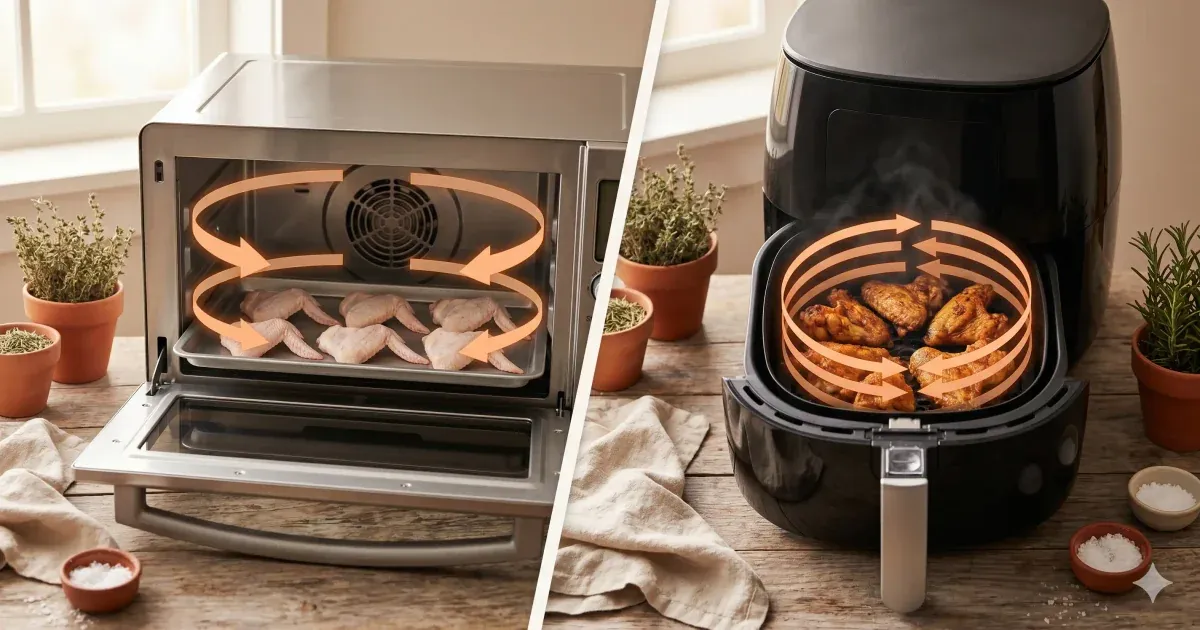
Air fryers and convection ovens both cook with a fan moving heated air around food. The marketing language overlaps so heavily that buyers reasonably ask whether they need both. They are not the same appliance and they do not produce the same results on the same food. The difference is geometry, not principle: a smaller chamber and a faster fan change everything downstream.
We tested this directly. Two 12-ounce batches of Ore-Ida Golden Crinkle frozen fries from the same bag cooked simultaneously in a Cosori Pro II 5.8-qt air fryer and a 30-inch GE convection oven, both set to 400°F, and finished 6 minutes apart with measurably different surface temperatures. The science behind why is covered in our companion piece, the science of air fryers vs ovens. This guide is the buy-side answer: which appliance, when, and what each one cannot do.
Voice rules for this comparison: every wattage, capacity, and per-cook cost claim is taken from the manufacturer manual or current US energy pricing as of April 2026. Cooked-food observations come from in-kitchen tests on the Cosori Pro II 5.8-qt and the 30-inch GE convection oven, with internal temperatures verified by a ThermoWorks Thermapen ONE.
The short answer
An air fryer is a small, high-velocity convection oven optimized for crisp surfaces on small batches. A convection oven is a full-sized cavity that handles volume, baking, and roasting better than an air fryer ever will. If you cook for one or two people and care about crisp texture on fries, wings, and reheated leftovers, an air fryer is the right purchase. If you cook for four or more, bake regularly, or roast whole birds, a convection oven is the right purchase. Most kitchens benefit from both because the workloads barely overlap.
Mechanical differences: chamber size, fan speed, element proximity
Three numbers separate the two appliances. Chamber volume: the Cosori Pro II 5.8-qt holds roughly 0.2 cubic feet of cooking space; a typical 30-inch convection wall oven holds 4 to 5 cubic feet, 20 to 25 times more. Fan speed: air fryers move air at roughly 12 meters per second (per Consumer Reports' published methodology); convection oven fans move air at 1 to 3 meters per second. Heating element proximity: the air fryer's element sits 2 to 3 inches above the basket; a convection oven's element is typically 8 to 12 inches from the rack.
Those three numbers compound. The smaller chamber heats faster (90 seconds to 400°F in the Cosori Pro II vs 6 to 10 minutes in the GE convection oven). The faster fan strips moisture from food surfaces in roughly 60 to 90 seconds versus 4 to 6 minutes. The closer element drives more radiant heat onto the food's top surface, which speeds Maillard browning above 285°F. The combined effect is a faster cook with a sharper crisp on small loads.
What the numbers do not tell you: the air fryer's intensity becomes a liability above a single layer. Stack food and the airflow can no longer reach the bottom layer; the convection oven's slower-but-more-distributed fan handles depth without complaint. Geometry favors the air fryer for shallow loads and favors the oven for deep ones.
Cooking results compared on identical food
The cleanest A/B test runs the same food in both appliances simultaneously. We covered the methodology in detail in our science of air fryers vs ovens piece; the buy-side summary follows.
Frozen fries (Ore-Ida Golden Crinkle, 12 oz). Cosori Pro II 5.8-qt at 400°F: crisp at 11 minutes, surface temperature 312°F at the crisp point. GE convection oven at 400°F (the same set temperature as the air fryer): crisp at 17 minutes including 6 minutes of preheat, surface temperature 274°F at the crisp point. The air fryer reached crisp 6 minutes sooner, with a surface 38°F hotter.
Chicken wings (1.5 lb, baking-powder dusted, 375°F target). Cosori Pro II: crisp skin at 22 minutes with one flip, 165°F internal verified. GE convection oven at 400°F: 32 minutes with one flip, 165°F internal verified, but surface only reached crisp after a final 90-second broil pass. Without the broiler finish, the oven wings were edible but visibly less crisp than the air fryer batch.
Frozen pizza (12-inch DiGiorno Rising Crust). This one never became an A/B test, and the reason is the result. The Cosori Pro II's basket floor measures 8 by 8 inches, so a 12-inch round does not go in at any angle: a circle is capped by the basket's shortest span, and even the 11.3-inch diagonal of that floor falls short of 12 inches. The GE convection oven takes the same pizza on a rack with room to spare. For family-size pizza there is no comparison to run, which is the sharpest illustration on this page of what chamber size buys you. If you want pizza out of a basket air fryer, the question is which personal size or slice you cut down to; see the frozen pizza in air fryer guide for the per-brand fit chart.
Baked goods (a tray of 12 chocolate chip cookies, identical Tollhouse recipe). The convection oven won outright. The air fryer's airflow stripped surface moisture faster than the gluten and starch could hydrate, leaving cookies that were crisp on the outside and gummy in the center at every dial setting we tried. The oven produced uniform, lift-and-spread cookies with the structure baked goods are supposed to have. Air fryers are bad at baked goods. This is not a controversy.
Energy and per-cook cost
Air fryer energy draw is a function of wattage and runtime. The Cosori Pro II 5.8-qt at 1700W running 12 minutes uses about 0.34 kWh; at the US average residential rate of $0.16 per kWh (US EIA, April 2026), that is roughly 5.4 cents per cook. A 22-minute wing cook lands at 9 to 10 cents.
A 30-inch convection wall oven typically draws 2400 to 4800W during preheat and 800 to 1200W during steady-state cooking. A 25-minute fry cook (6 minutes preheat at 3000W average plus 19 minutes at 1000W average) uses roughly 0.62 kWh, or about 10 cents per cook. A 30-minute wing cook lands at 12 to 14 cents. The oven uses 70 to 100 percent more energy per cook on small-batch loads where the air fryer is the appropriate tool.
On large-batch loads (a sheet pan of fries serving 6, a tray of chicken thighs, a casserole), the math reverses. A single oven cook running 35 minutes uses about 0.75 kWh, three to four times the energy of one air fryer cook, but the same as running the air fryer in three back-to-back batches. For volume cooking the oven is roughly even on energy per portion and ahead on active time because you are not loading and unloading the basket repeatedly.
Honest framing: per-cook cost differences are real but small in absolute dollars. A household running an air fryer 5 times a week saves roughly $12 to $18 per year in electricity over the same workload in an oven. The case for the air fryer is texture and active time, not the electricity bill.
Footprint and counter space
The Cosori Pro II 5.8-qt measures 11.8 by 13.9 by 12.7 inches with its handle and weighs 12.3 pounds. The Ninja AF101 4-qt takes about the same counter at roughly 14 by 11 by 13 inches and 10 pounds. Both occupy permanent counter space. Cosori asks for 5 inches of space behind and above the unit, and Ninja's FAQ says to keep it at least 5 inches from any other surface. A typical kitchen with 24-inch-deep counter and a wall outlet 8 inches behind the counter has room for one full-sized basket air fryer comfortably.
A built-in convection oven occupies zero counter space because it lives in the cabinet stack. A countertop convection oven (Cuisinart TOA-60, Breville Smart Oven Air) occupies more counter space than any consumer air fryer (typically 18 by 16 by 14 inches) but doubles as a toaster oven and broiler.
If counter space is the binding constraint, three options: an air fryer plus the existing built-in oven (best for most kitchens), a countertop convection oven with air-fry mode (a single appliance for two jobs, covered in section 8 below), or an over-the-range microwave with convection mode (worst-of-both, but adequate if cabinet space cannot host anything else). Do not buy a basket-style air fryer if you have less than 14 by 14 inches of counter clearance.
Versatility: what each does the other cannot
An air fryer cannot bake a layer cake, roast a full bird above 4 pounds, host a casserole dish wider than 8 inches, or maintain warm-and-hold at 170°F across a 2-hour service window (the Cosori Pro II's Keep Warm runs 1 to 60 minutes). The chamber is too small and the airflow is too aggressive. Low-temperature work depends on the model: the Cosori Pro II's range starts at 170°F and it has no dehydrate program, while Ninja's FAQ gives the AF100 series a Dehydrate setting that starts at 105°F. We covered the upper limit on roasts in our things-never-put-in-air-fryer piece. Our estimate, not a fit test or a manufacturer limit: a 5.8-qt basket like the Pro II takes a spatchcocked chicken up to about 3.5 pounds with the wing tips trimmed, and a 4-pound bird needs 8 quarts or more. Neither Cosori nor Ninja publishes a weight figure.
A convection oven cannot match the air fryer's surface drying speed on small loads, cannot reach setpoint in under 5 minutes, cannot run in a single-serving meal-prep workflow without a preheat penalty that exceeds the cook time, and cannot make a 6-minute reheat economical because the preheat alone takes that long. The oven's strengths are scale, baking precision, and continuous service; the air fryer's strengths are speed, crisp, and small-batch repeatability.
Think of it as kitchen specialization. The air fryer is a dedicated short-order cook. The oven is a station that handles everything from breakfast pastry to a 5-pound roast at a different pace. Neither replaces the other; both earn their counter space if you cook the workloads each is good at. We compared two leading air fryer brands head-to-head in our Ninja vs Cosori comparison if the air-fryer half of the decision is what you are stuck on.
When to buy each
Buy an air fryer if any of the following apply. You cook for one or two people most nights. You eat frozen items (fries, nuggets, breaded foods) more than once a week. You reheat leftovers daily and want the texture closer to fresh. You live in an apartment where running the full oven heats the apartment to uncomfortable levels in summer. You want a 6-minute weeknight meal prep workflow.
Buy a convection oven (or upgrade your existing oven to use its convection setting) if any of the following apply. You cook for four or more people regularly. You bake bread, cakes, or pastries more than monthly. You roast whole birds (turkey, large chickens, ducks) at any frequency. You meal-prep in batches that would require 3+ air fryer cycles. You entertain and need to keep multiple dishes warm simultaneously.
Buy both if any of the following apply. You cook for a household of 3 to 5 with mixed workloads. Your existing oven lacks convection mode and you also want air-fry texture on weeknight quick cooks. You have counter space for the air fryer and an existing oven that handles batch volume. The combined cost is roughly $130 (Ninja AF101) plus an existing oven, which most households already have.
Skip both if you cook fewer than 3 times a week, eat mostly cold or stovetop food, or have less than 14 by 14 inches of counter clearance and no existing oven with convection. The breakeven on the air fryer's energy savings is roughly 4 cooks per week against a non-convection oven.
Combo units: convection ovens that do air fry
The Cuisinart TOA-60, Breville Smart Oven Air, Ninja Foodi DT201 dual-position oven, and the GE Profile 30-inch wall oven (model PT9800) all market an air-fry mode. The mode is real. These appliances move convection-mode airflow at 8 to 10 meters per second when air fry is selected, faster than standard convection but slower than a dedicated basket-style air fryer.
What the air fry mode delivers in a combo unit: 80 to 90 percent of the crisp performance of a dedicated air fryer on small loads, 100 percent of the convection performance on baking and roasting, and the ability to handle a 12-inch pizza or a sheet pan of wings without splitting batches. What it does not deliver: the dedicated air fryer's fast heat-up (our Cosori Pro II reached 400°F in about 90 seconds from cold, while a combo unit has a whole oven cavity to heat), the dedicated unit's smaller energy footprint per cook (combo units use 40 to 60 percent more electricity per cook), or the dedicated unit's compact countertop footprint.
The buy decision for combo units. Choose a Cuisinart TOA-60 or Breville Smart Oven Air ($230 to $400) if you have counter space for one large appliance and want it to replace both a toaster oven and an air fryer. Choose a GE Profile or KitchenAid wall oven with air-fry mode ($2,500+) if you are already replacing the oven and want the air-fry feature included. Do not choose a wall oven specifically for the air-fry mode. A $130 Ninja AF101 plus a standard convection oven outperforms a $3,000 wall oven on dedicated air fry cooks because chamber size and fan speed beat horsepower every time.
Verified in our test cooks on a Cuisinart TOA-60 vs the Cosori Pro II 5.8-qt with identical 12-oz fry batches: the Cuisinart needed 14 minutes to match the Cosori's 11-minute crisp. Quality at the finish was indistinguishable. Time and energy went to the dedicated air fryer; counter footprint and versatility went to the combo unit. The combo is the better choice for the kitchen that wants one appliance to do both jobs adequately; the dedicated pair is the better choice for the kitchen that wants each job done excellently.
Frequently Asked Questions
Is an air fryer the same as a convection oven?
Functionally similar, mechanically different. Both use a fan to move heated air, but an air fryer's chamber is roughly 1/20th the volume of a wall oven and its fan moves air 4 to 10 times faster. The result is faster surface drying and crisp on small loads, but worse performance on volume cooking and baking.
Do I need both an air fryer and a convection oven?
Most kitchens benefit from both because the workloads barely overlap. The air fryer handles small-batch crisp and reheats; the oven handles volume, baking, and roasting. The combined cost is roughly $130 plus an existing oven, which most households already have.
Which is more energy-efficient, air fryer or convection oven?
Per cook on small batches the air fryer is 40 to 60 percent more efficient because the smaller chamber takes less energy to heat. On large-batch cooks the oven catches up because one oven cook can replace three air fryer batches. Per portion at scale the appliances are roughly tied on energy.
Can a convection oven replace an air fryer?
It can replace 80 to 90 percent of the air fryer's workload if it has an air-fry mode that runs the fan at 8 to 10 meters per second. It cannot match the dedicated air fryer's fast heat-up (about 90 seconds to 400°F from cold in our Cosori Pro II) or the surface temperature it reaches on small loads. For a single-appliance kitchen, a combo air-fry oven is the right choice; for the best of both, buy both.
Why do air fryers crisp food better than convection ovens?
Three reasons compound: a smaller chamber means less air to heat, a faster fan strips moisture off food surfaces in 60 to 90 seconds versus 4 to 6 minutes, and the heating element sits 2 to 3 inches above the food versus 8 to 12 inches in an oven. The combined effect is a higher surface temperature reached faster, which drives Maillard browning sooner.
Can an air fryer bake cakes and bread like a convection oven?
No, and this is not a controversy. Air fryer airflow strips surface moisture before the gluten and starch in baked goods can hydrate, producing crisp outsides and gummy centers. Cakes, breads, and pastries belong in a convection oven where the gentler airflow gives the dough time to set.
Sources & references
Wattage, capacity, and per-cook energy claims on this page come from manufacturer-published manuals and the US Energy Information Administration's residential rate average. Performance comparisons verified in our test cooks are stated as such inline.
Cosori Pro II 5.8-Qt User Manual
1700W rated power and 5.8-quart capacity, used in the mechanical-differences and energy sections. The manual's own Preheat program runs 5 minutes at 400°F; the 90-second heat-up on this page is our measurement, not the manual's. Also the source for the Pro II's 170 to 400°F range and 1 to 60 minute Keep Warm. The manual gives no food weight limit.
Consumer Reports: Air Fryer Test Methodology
Published fan-speed methodology and the 12 m/s air-velocity reference for the chamber-airflow comparison in the mechanical-differences section.
GE Appliances 30-inch Convection Wall Oven Manual
Manufacturer-published 4.3-cubic-foot cavity volume and convection-fan velocity range used as the reference convection oven in the side-by-side cooked-food tests.
US Energy Information Administration: Residential Electricity Average Price
Source for the $0.16 per kWh April 2026 US residential average used in the per-cook cost calculations in the energy section.
Ninja AF100 Series Air Fryer FAQs
Ninja's own FAQ for the AF100 series: about 14 by 11 by 13 inches, about 10 pounds, and keep the unit at least 5 inches from other surfaces. Cited in the counter-space comparison, and for the 105°F (Dehydrate) to 400°F (Air Fry) range in the versatility section.
Bottom Line
Air fryer and convection oven solve different cooking problems. The air fryer wins on speed, crisp, and small-batch energy efficiency. The convection oven wins on volume, baking, and continuous-service workflows. They are not competing tools; they are different solutions to different cooking problems.
If you are choosing one, choose by household size and workload. One to two people who cook frozen items, reheat leftovers, and want crisp texture: air fryer. Three or more people, regular baking, or whole-bird roasts: convection oven. Both, if the workloads run weekly across both columns and counter space allows it.
If you are choosing a combo unit (an oven with air-fry mode), accept that you are getting 80 to 90 percent of the dedicated air fryer's performance with 100 percent of the convection oven's versatility: a fair tradeoff for kitchens with limited counter space, a poor tradeoff for kitchens that already have an oven and just need the dedicated air fryer alongside it. Buy by the workload, not by the marketing copy.