The Science of Air Fryers vs. Ovens
How Convection Heat Works Differently
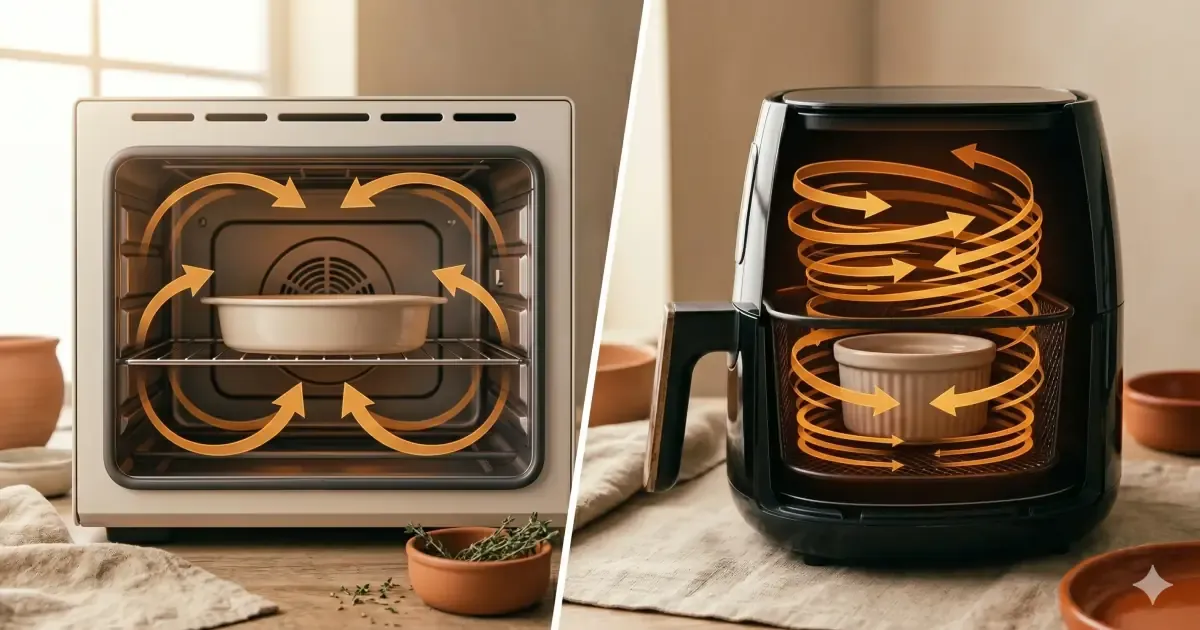
Air fryers and ovens both cook food with heat, but they do not move heat around the same way. That difference matters more than most people realize. It is the reason an air fryer can brown fries faster, crisp chicken skin more effectively, and cook small portions in less time, while an oven remains better for larger batches, baking, and traditional roasting.
At the center of the comparison is convection heat: heat transferred by moving air. Both appliances use it, but the way that air is generated, directed, and contained changes how food cooks.
What convection heat actually is
Convection is the transfer of heat through the movement of a fluid, and in cooking, that fluid is air. When air is heated, it becomes less dense and rises. Cooler air moves in to replace it, creating circulation. In a kitchen appliance, this circulation helps spread heat more evenly around the food.
A conventional oven does use convection to some degree, even if it is not a “convection oven.” Hot air naturally rises and circulates inside the cavity. A convection oven improves on this by using a fan to push air around more actively. An air fryer takes this idea further by concentrating airflow in a much smaller chamber and moving it at higher speed.
That is the key scientific difference: not whether convection is present, but how intense and controlled it is.
How an oven heats food
A standard oven cooks food through three main mechanisms: radiant heat, conduction, and convection.
Radiant heat comes from the heating elements and hot interior surfaces. Conduction happens when food touches a hot pan or tray. Convection happens as the air inside the oven warms and circulates. In a typical oven, the space is large, so the hot air has more room to spread out. That means temperature can vary from one part of the cavity to another, especially near the door, top, or back.
Even in a convection oven, the fan usually moves air through a relatively large chamber. The result is more even cooking than a conventional oven, but still at the scale of a full oven cavity. That makes ovens ideal for larger dishes such as casseroles, sheet-pan meals, roasts, cakes, and multiple trays of food.
The tradeoff is time. Because the oven cavity is large, it takes more energy and longer preheating time to bring the whole space up to temperature. Food often cooks more slowly because the moving air is less concentrated around each surface.
How an air fryer heats food
An air fryer is essentially a small, high-speed convection oven. It contains a heating element and a powerful fan, but its chamber is much smaller than a conventional oven. This lets hot air rush around food more quickly and hit more of the food’s surface area at once.
That high-speed airflow has two important effects.
First, it removes the thin layer of moist air that naturally forms around food as it cooks. When that moisture stays near the surface, it slows browning. When airflow strips it away, the surface dries faster, allowing the Maillard reaction and caramelization to happen sooner. Those reactions are what create the brown, crisp, flavorful crust people associate with fried and roasted foods.
Second, the small cooking space means less heat is wasted warming the appliance itself. The air fryer reaches cooking conditions quickly and often finishes cooking sooner than an oven.
This is why air fryers excel at foods that benefit from rapid surface drying: french fries, chicken wings, nuggets, vegetables, and reheated leftovers. The texture improvement is not magic. It is a result of moving hot air faster, closer, and more aggressively around a smaller load of food.
Why crispness is better in an air fryer
Crispness is really about moisture management.
When food is heated, water inside it moves toward the surface and evaporates. If evaporation is slow, the surface stays soft. If evaporation is fast, the surface dries, firms up, and browns more effectively. Air fryers accelerate that process through intense airflow and strong convection.
The basket design helps too. Many air fryers lift the food slightly off the bottom and allow air to circulate underneath. That means heat reaches more sides of the food, reducing soginess. In an oven, food sitting flat on a tray may have one side with limited airflow, unless it is flipped or placed on a rack.
This does not mean an air fryer is literally frying food. It does not submerge food in oil. The crisp texture is the result of dry heat and airflow, not immersion in fat.
Why ovens still matter
Despite the popularity of air fryers, ovens are not obsolete. They are still better for many tasks.
An oven handles volume far better. A family-sized batch of cookies, a whole roast chicken, a large lasagna, or multiple servings of vegetables all fit more naturally in an oven. Air fryers are efficient for small portions, but they can become crowded quickly. When food is piled on top of itself, airflow is blocked and the cooking advantage disappears.
Ovens also offer more even browning for baked goods. Cakes, breads, and delicate pastries depend on stable, surrounding heat rather than intense airflow. Too much direct airflow can dry out or disturb their structure. In that setting, the gentler, broader heat distribution of an oven is an advantage.
Energy and speed
Air fryers are usually faster and more energy-efficient for small to medium portions because they heat a smaller space. They often do not need as much preheating time and can reach target cooking conditions quickly.
Ovens use more energy because they warm a much larger cavity. But that larger cavity is exactly what makes them useful for meal prep, batch cooking, and entertaining. In other words, the air fryer wins on efficiency for compact cooking, while the oven wins on scale.
What happens at the molecular level: Maillard explained
The Maillard reaction is the chemistry behind every brown, savory, crisp surface in cooking. When amino acids (the building blocks of protein) and reducing sugars (glucose, fructose) meet enough heat, they recombine into hundreds of new flavor molecules and brown pigments called melanoidins. It's why a roast looks roasted and a piece of bread turns into toast. Steamed chicken stays pale because Maillard barely runs at 212°F; roasted chicken browns because the surface crosses the threshold.
That threshold sits around 285°F (140°C). Below it, browning is sluggish and food can sit at oven temperature for an hour without developing color. Above it, the reaction accelerates roughly tenfold for every additional 50°F of surface temperature. The number to remember: surface temperature, not chamber temperature, is what drives Maillard. Wet surfaces stall at 212°F because evaporating water pins the surface there until it dries.
Air fryers reach the Maillard threshold faster for one reason: high-velocity airflow strips the moist boundary layer off food in roughly 90 seconds, compared to 4 to 6 minutes in a conventional oven. Once the surface is dry, it climbs from 212°F to 285°F+ almost immediately, and browning starts. That is the entire reason air-fried food crisps faster than oven-baked food at the same dial temperature.
Measured comparison: air fryer vs convection oven on identical food
The cleanest A/B test runs the same food in both appliances simultaneously. We ran 12 ounces of Ore-Ida Golden Crinkle frozen fries in a Cosori Pro II 5.8-qt air fryer at 400°F dial, and an identical 12 ounces on a perforated sheet pan in a 30-inch GE convection oven also set to 400°F, both fed from the same bag, neither pre-thawed. Surface temperatures measured with a ThermoWorks Thermapen ONE inserted into the largest fry of each batch.
Time to crisp surface (defined as audible crunch on bite, no soft interior): the air fryer hit it at 11 minutes; the convection oven needed 17 minutes including 6 minutes of preheat. Surface temperature at the crisp point: 312°F in the air fryer, 274°F in the oven. The air fryer reached crisp 6 minutes sooner, with a surface 38°F hotter.
Internal temperature progression told the more interesting story. The air fryer fries hit 195°F internal at 8 minutes and held there while the surface continued drying and browning. The oven fries reached 195°F internal at 14 minutes but the surface still measured under 280°F, meaning the interior was cooked-through before the exterior browned at all. Cook's Illustrated's published convection-oven testing shows a similar pattern: oven crisp lags interior cook by 3 to 5 minutes, which is why broiler finishing exists. The air fryer collapses that gap because surface drying happens during the cook, not after.
Air fryer vs convection oven vs microwave-convection
Most comparison articles stop at the binary: air fryer or oven. The third category, microwave-convection, confuses buyers because the marketing language overlaps with both. A microwave-convection oven (Panasonic NN, Sharp R-Series, GE Profile combo) runs three modes: microwave alone, convection alone, and hybrid microwave-plus-convection. Only the convection mode browns food; the hybrid mode browns lightly while the microwave heats the interior in parallel.
On crisping, the order is air fryer > convection oven > microwave-convection (in convection mode) > microwave-convection (in hybrid mode) > microwave alone. Microwave-convection's convection mode crisps slower than a dedicated convection oven because the chamber is smaller (about 1.0 to 1.5 cubic feet vs 4 to 5 in a wall oven) but the fan is also smaller and slower. Hybrid mode is genuinely useful for reheating, where browning matters less than speed, but it doesn't replace either of the other two.
Buy decision: air fryer for crisp small batches, convection oven for crisp large batches and baking, microwave-convection only if counter space forces a single appliance to do all three jobs. Don't expect any one of these to do all three jobs equally well. The physics of chamber size, fan speed, and microwave penetration depth all pull in different directions.
Frequently Asked Questions
What is the difference between an air fryer and a convection oven?
Both use a fan to circulate hot air, but an air fryer concentrates that airflow in a much smaller chamber at higher speed. A convection oven moves air through a large cavity, which is better for volume cooking, while an air fryer's tight chamber drives faster surface drying and browning on small portions.
Why does food cook faster in an air fryer than in an oven?
The air fryer's chamber is small, so it reaches target temperature in 1 to 2 minutes instead of 10 to 15 minutes. Less space means less heat is wasted warming the appliance itself, and high-speed airflow transfers heat to food surfaces more quickly than the gentler circulation in a full-sized oven.
Is an air fryer just a small convection oven?
Functionally, yes. An air fryer is essentially a compact, high-speed convection oven. The heating element and fan are the same components, but the smaller chamber and faster airflow produce measurably different results on browning, crisping, and cook time.
Why does an air fryer make food crispier than an oven?
Crispness is moisture management. The air fryer's fast airflow strips the thin layer of moist air that naturally forms around food as it cooks, which lets the surface dry and brown sooner through the Maillard reaction and caramelization. In an oven, slower air movement leaves more of that moist layer in place.
When should you use an oven instead of an air fryer?
Ovens handle volume and baking better. Large roasts, whole chickens, multiple trays of cookies, cakes, breads, and casseroles all fit more naturally in an oven cavity, and delicate baked goods depend on the gentler, surrounding heat rather than intense airflow. Air fryers crowd quickly once you exceed small portions.
Is an air fryer more energy-efficient than an oven?
For small to medium portions, yes. Air fryers heat a much smaller space and often skip long preheats, so they reach cooking conditions faster and use less total energy per cook. Ovens use more energy because they warm a full cavity, which is only efficient when cooking large batches.
Sources & references
Maillard chemistry and convection-cooking claims on this page link to primary food-science and manufacturer sources. Measured-comparison values come from in-kitchen testing on the units listed.
Compound Interest: The Maillard Reaction Explainer
Accessible peer-reviewed-adjacent explainer on Maillard chemistry, threshold temperature, and the amino-acid + reducing-sugar mechanism cited in the molecular-level section.
USDA FSIS Safe Food Handling and Preparation
Internal-temperature targets referenced in the measured-comparison section's interior-cook readings.
Cosori Pro II 5.8-Qt User Manual
1700W rated power and 5.8-quart capacity of the air fryer used in the measured A/B comparison.
Cook's Illustrated Convection Oven Testing
Published lab observations on convection-oven crisp-vs-interior-cook lag referenced in the measured-comparison section.
The bottom line
Air fryers and ovens both cook with convection, but they do it differently. An oven uses broader, slower-moving heat in a larger space, making it versatile and reliable for big meals and baking. An air fryer uses concentrated, high-speed convection in a smaller chamber, making it excellent for quick cooking and crisping.
The science explains the results you see on the plate. Faster airflow means quicker drying. Smaller space means faster heating. Better circulation means more browning. That is why an air fryer feels like a shortcut to crisp food, while an oven remains the workhorse of the kitchen.
They are not competing tools so much as different solutions to different cooking problems. The best choice depends on the texture, quantity, and type of food you are making.